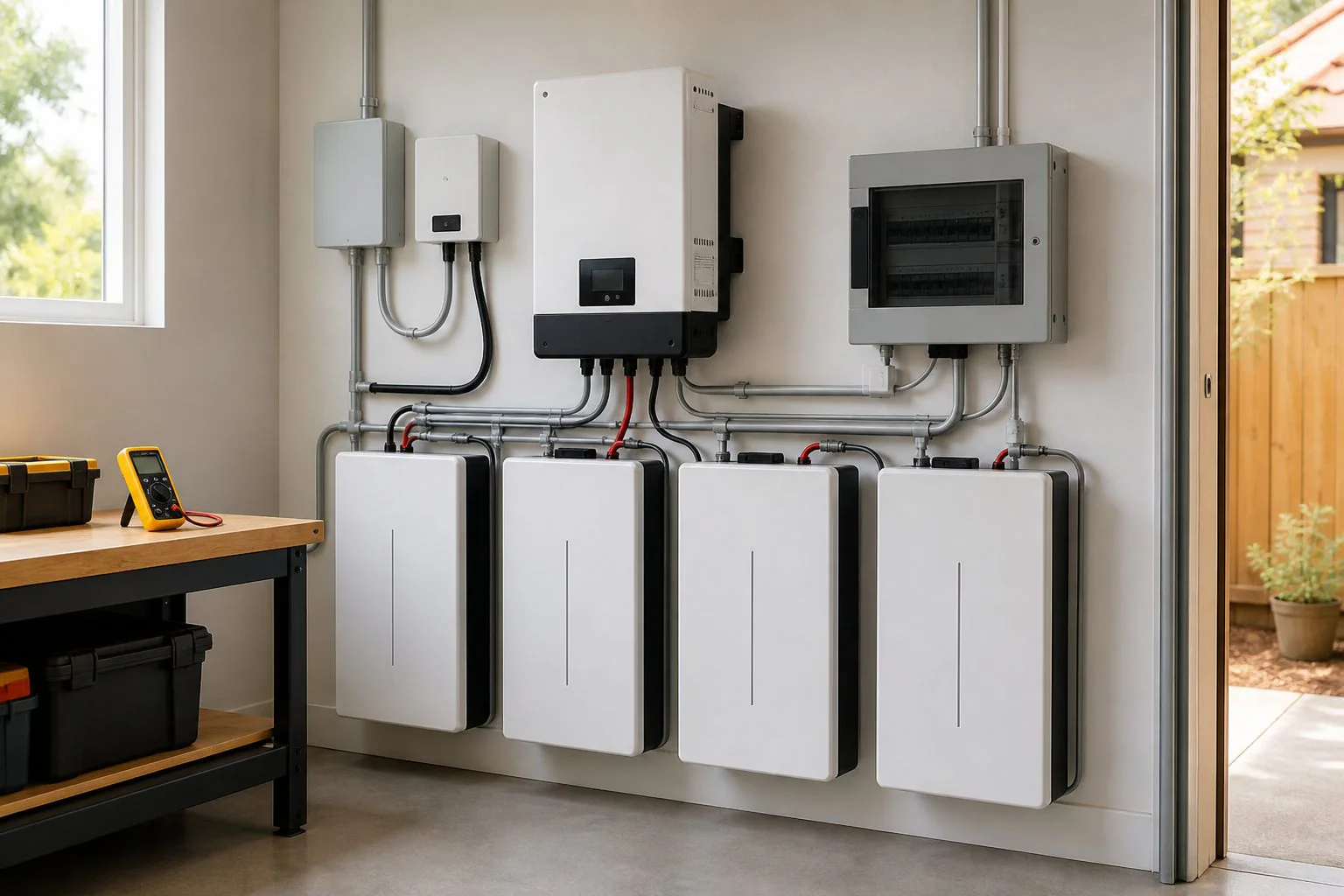
Converting kilowatt hours to amp hours is simple once you know the battery voltage. Kilowatt-hours measure electrical energy, while amp-hours measure electrical charge. Because they describe different quantities, there is no fixed number of amp-hours in one kilowatt-hour.
At 12 volts, 1 kWh equals approximately 83.33 Ah. The same energy equals 41.67 Ah at 24 volts and 20.83 Ah at 48 volts. Higher voltage reduces the amp-hour capacity required to store the same amount of energy.
The basic formula is Ah = (kWh × 1,000) ÷ voltage. That formula gives the theoretical capacity. If you are sizing a solar battery, off-grid battery bank, or home backup system, you may also need to account for depth of discharge, inverter efficiency, battery losses, temperature, and aging.
Quick Answer
To convert kWh to Ah, multiply the kilowatt-hours by 1,000 and divide by the battery voltage:
Amp-hours = (Kilowatt-hours × 1,000) ÷ Volts
For 1 kWh:
| Battery voltage | Capacity |
|---|---|
| 12 V | 83.33 Ah |
| 24 V | 41.67 Ah |
| 36 V | 27.78 Ah |
| 48 V | 20.83 Ah |
| 51.2 V | 19.53 Ah |
You cannot accurately convert kWh to Ah without voltage because identical energy capacities can have very different amp-hour ratings at different voltages.
What Do kWh and Ah Actually Measure?
Although both units appear on battery specification sheets, they do not measure the same property.
A kilowatt-hour, abbreviated kWh, is a unit of electrical energy. One kilowatt-hour equals 1,000 watt-hours. It could represent a 1,000-watt appliance operating for one hour or a 100-watt device running for ten hours. NIST defines a kilowatt-hour as an energy quantity equal to 1,000 watt-hours.
An amp-hour, abbreviated Ah, measures electrical charge. A 100 Ah battery could theoretically supply 5 amps for 20 hours or 10 amps for 10 hours under ideal conditions. One amp-hour corresponds to 3,600 coulombs, according to the NIST Guide to the SI.
The missing link between energy and charge is voltage:
Watt-hours = Amp-hours × Volts
For example, a 100 Ah battery rated at 12 V stores approximately:
100 Ah × 12 V = 1,200 Wh = 1.2 kWh
A 100 Ah battery rated at 48 V stores approximately:
100 Ah × 48 V = 4,800 Wh = 4.8 kWh
Both batteries have the same amp-hour rating, but the 48 V battery stores four times as much theoretical energy.
Kilowatt Hours to Amp Hours Formula

The standard kWh-to-Ah formula is:
Ah = (kWh × 1,000) ÷ V
Where:
- Ah is capacity in amp-hours
- kWh is energy in kilowatt-hours
- 1,000 converts kilowatt-hours to watt-hours
- V is the battery’s nominal voltage
Suppose you have a 5 kWh battery rated at 48 V:
Ah = (5 × 1,000) ÷ 48
Ah = 104.17
The battery therefore has a theoretical capacity of approximately 104.17 Ah at 48 V.
You can also reverse the calculation:
kWh = (Ah × V) ÷ 1,000
A 200 Ah battery at 24 V would store:
kWh = (200 × 24) ÷ 1,000 = 4.8 kWh
These equations describe nominal energy capacity. They do not automatically tell you how much energy can reach an appliance after real-world losses.
How to Convert kWh to Ah Step by Step
A reliable conversion only takes three steps.
1. Confirm the energy capacity
Find the battery capacity or energy requirement in kilowatt-hours. If the value is already in watt-hours, you do not need to multiply it by 1,000.
For example:
2.4 kWh × 1,000 = 2,400 Wh
2. Identify the correct battery voltage
Use the nominal voltage printed on the battery or listed in its specification sheet. Common system voltages include 12 V, 24 V, 36 V, 48 V, and 51.2 V.
Do not use a household AC voltage such as 120 V or 230 V when calculating the capacity of a 48 V DC battery bank. Use the voltage of the battery system being sized.
3. Divide watt-hours by voltage
For 2.4 kWh at 24 V:
Ah = 2,400 Wh ÷ 24 V
Ah = 100 Ah
Therefore, a 2.4 kWh battery at 24 V has a nominal capacity of 100 Ah.
kWh-to-Ah Conversion Chart by Voltage
The following kilowatt-hours-to-amp-hours conversion table uses nominal voltage and assumes an ideal calculation with no losses.
| Energy | 12 V | 24 V | 36 V | 48 V | 51.2 V |
|---|---|---|---|---|---|
| 1 kWh | 83.33 Ah | 41.67 Ah | 27.78 Ah | 20.83 Ah | 19.53 Ah |
| 2 kWh | 166.67 Ah | 83.33 Ah | 55.56 Ah | 41.67 Ah | 39.06 Ah |
| 3 kWh | 250.00 Ah | 125.00 Ah | 83.33 Ah | 62.50 Ah | 58.59 Ah |
| 5 kWh | 416.67 Ah | 208.33 Ah | 138.89 Ah | 104.17 Ah | 97.66 Ah |
| 10 kWh | 833.33 Ah | 416.67 Ah | 277.78 Ah | 208.33 Ah | 195.31 Ah |
| 15 kWh | 1,250.00 Ah | 625.00 Ah | 416.67 Ah | 312.50 Ah | 292.97 Ah |
The table also demonstrates why voltage must be included in a battery capacity conversion. A 5 kWh battery would be rated at about 416.67 Ah at 12 V but only 104.17 Ah at 48 V. Its theoretical stored energy remains 5 kWh in both cases.
Why Higher Voltage Produces Fewer Amp-Hours

At first, it may seem as though a 48 V battery with 100 Ah offers less capacity than a 12 V battery with 200 Ah. Looking only at amp-hours creates the wrong impression.
Calculate the energy of each battery:
- 48 V × 100 Ah = 4,800 Wh, or 4.8 kWh
- 12 V × 200 Ah = 2,400 Wh, or 2.4 kWh
The 48 V battery stores twice as much theoretical energy despite having half the Ah rating.
Higher-voltage battery systems can deliver a given amount of power with less current. That can reduce resistive losses and may allow more manageable conductor sizes, although wiring and protection must still be designed for the actual installation.
When comparing batteries with different voltages, kWh or Wh provides a clearer energy comparison than Ah alone.
Nominal Capacity Is Not the Same as Usable Capacity
The basic formula converts rated energy into rated amp-hours. A working battery system may need more nominal capacity than the simple answer suggests.
Important real-world factors include:
- permitted depth of discharge
- inverter efficiency
- battery discharge efficiency
- cable and connection losses
- discharge rate
- operating temperature
- battery age
- reserve capacity
- battery-management-system limits
Depth of discharge, or DoD, represents the percentage of total capacity removed from a battery. If a system is designed to use only 80% of its rated capacity, a nominal 10 kWh battery provides approximately 8 kWh before other losses.
Inverter efficiency also matters when a DC battery powers AC appliances. Some stored energy is lost while the inverter converts DC electricity into AC electricity.
Battery behavior can vary with discharge rate and temperature as well. Victron notes that effective battery capacity can depend on discharge rate, temperature, and charge efficiency. These effects are particularly relevant when estimating the practical capacity of lead-acid batteries.
Calculating the Battery Capacity You Actually Need
To size a battery from required usable energy, divide by the usable depth of discharge and system efficiency before converting to amp-hours:
Required Ah = (Required kWh × 1,000) ÷ (Voltage × DoD × efficiency)
Write depth of discharge and efficiency as decimals. For example, 80% becomes 0.80 and 90% becomes 0.90.
Imagine that a home backup system must deliver 5 kWh of usable AC energy. It uses a 48 V battery, allows 80% depth of discharge, and has an estimated overall efficiency of 90%.
Required Ah = (5 × 1,000) ÷ (48 × 0.80 × 0.90)
Required Ah = 5,000 ÷ 34.56
Required Ah ≈ 144.68 Ah
A simple ideal conversion would produce only 104.17 Ah:
5,000 ÷ 48 = 104.17 Ah
That number describes 5 kWh of nominal stored energy, not the installed capacity needed to deliver 5 kWh after the stated limits and losses. Under these assumptions, the system needs approximately 144.68 Ah. In practice, the capacity would usually be rounded up to an available battery size with an appropriate design margin.
Examples for Solar and Backup Batteries
1 kWh to Ah at 12 V
For a small 12 V battery system:
Ah = 1,000 ÷ 12
Ah = 83.33 Ah
A nominal 12 V, 100 Ah battery stores approximately 1.2 kWh. The usable amount may be lower depending on chemistry, discharge limits, and system efficiency.
2 kWh to Ah at 24 V
For a 24 V system:
Ah = 2,000 ÷ 24
Ah = 83.33 Ah
This is the same Ah result as 1 kWh at 12 V because both energy and voltage have doubled.
5 kWh to Ah at 48 V
For a 48 V solar battery:
Ah = 5,000 ÷ 48
Ah = 104.17 Ah
If the actual battery is rated at 51.2 V, as is common for some lithium iron phosphate configurations, use that value instead:
Ah = 5,000 ÷ 51.2 = 97.66 Ah
Daily energy consumption to battery Ah
Suppose an off-grid system uses 4 kWh per day. The battery bank operates at 48 V, with 80% permitted DoD and 92% overall efficiency:
Required Ah = 4,000 ÷ (48 × 0.80 × 0.92)
Required Ah ≈ 113.22 Ah
This calculation provides a starting point. A full solar battery sizing assessment may also account for cloudy-day autonomy, seasonal production, maximum discharge current, inverter surge requirements, and future capacity loss.
Series and Parallel Connections Change the Numbers Differently

Battery arrangement affects voltage and amp-hour capacity.
When identical batteries are connected in series, their voltages add while the amp-hour rating remains the same. Two 12 V, 100 Ah batteries in series form a 24 V, 100 Ah bank:
24 V × 100 Ah = 2,400 Wh = 2.4 kWh
When identical batteries are connected in parallel, voltage remains the same while amp-hours add. Two 12 V, 100 Ah batteries in parallel form a 12 V, 200 Ah bank:
12 V × 200 Ah = 2,400 Wh = 2.4 kWh
Both arrangements provide the same theoretical energy because each uses two identical batteries. However, the system voltage and current behavior differ.
Only connect batteries in configurations approved by the manufacturer. Battery chemistry, model, capacity, age, state of charge, wiring, fusing, and battery-management requirements must be compatible.
Common Conversion Mistakes
The arithmetic is straightforward, but several input errors can produce misleading results.
Trying to convert without voltage
There is no universal answer to how many Ah are in 1 kWh. The result is 83.33 Ah at 12 V, 41.67 Ah at 24 V, and 20.83 Ah at 48 V.
Confusing kW with kWh
A kilowatt measures power, while a kilowatt-hour measures energy. Battery capacity is normally expressed in kWh, Wh, or Ah—not simply kW.
Confusing amps with amp-hours
Amps measure current at a particular moment. Amp-hours measure electrical charge accumulated or delivered over time. Converting kWh to amps requires a time period as well as voltage; converting kWh to Ah requires voltage.
Using AC load voltage instead of battery voltage
A 48 V battery system may supply a 120 V or 230 V appliance through an inverter. For battery kWh-to-Ah conversion, use the nominal DC battery voltage, not the appliance’s AC voltage.
Ignoring usable capacity
A theoretical conversion is not a complete battery-sizing calculation. Depth of discharge, efficiency, reserve requirements, and aging can all increase the nominal capacity needed.
Assuming the Ah label guarantees runtime
Battery runtime depends on load power, usable energy, efficiency, temperature, discharge rate, and battery condition. A capacity label alone cannot guarantee how long an appliance will operate.
Frequently Asked Questions
How many amp hours are in 1 kWh?
The answer depends on voltage. One kWh equals approximately 83.33 Ah at 12 V, 41.67 Ah at 24 V, 27.78 Ah at 36 V, 20.83 Ah at 48 V, and 19.53 Ah at 51.2 V. Use Ah = 1,000 ÷ voltage for the ideal conversion.
Can you convert kWh to Ah without voltage?
No. Kilowatt-hours measure energy, while amp-hours measure charge. Voltage connects the two units through the relationship Wh = Ah × V. Without voltage, a single kWh value could correspond to many different amp-hour capacities, so the conversion would be incomplete.
What is the difference between kWh and Ah?
Kilowatt-hours measure how much energy a battery stores or supplies. Amp-hours measure electrical charge and only describe energy capacity when paired with voltage. For comparing batteries that operate at different voltages, kWh or Wh is generally more informative than Ah alone.
How many Ah is a 5 kWh battery?
A 5 kWh battery equals approximately 416.67 Ah at 12 V, 208.33 Ah at 24 V, 104.17 Ah at 48 V, or 97.66 Ah at 51.2 V. These are nominal values and do not include depth-of-discharge limits or system losses.
How many kWh is a 100 Ah battery?
Multiply the amp-hours by voltage, then divide by 1,000. A 12 V, 100 Ah battery stores about 1.2 kWh. A 24 V, 100 Ah battery stores 2.4 kWh, while a 48 V, 100 Ah battery stores approximately 4.8 kWh.
How do you include inverter efficiency in a kWh-to-Ah calculation?
If the target represents usable AC energy, divide by inverter or overall system efficiency. For a 48 V system delivering 5 kWh through an inverter at 90% efficiency, the calculation is 5,000 ÷ (48 × 0.90), giving approximately 115.74 Ah before accounting for depth-of-discharge limits.
Is a 51.2 V battery the same as a 48 V battery?
A 51.2 V battery may be marketed as part of a nominal 48 V system, but the two voltage values produce slightly different capacity calculations. For accurate battery energy conversion, use the nominal voltage listed in the manufacturer’s specification sheet rather than assuming exactly 48 V.
How long will a 1 kWh battery last?
Divide usable battery energy in watt-hours by the load in watts. An ideal 1 kWh battery could run a constant 100 W load for ten hours. Actual runtime will normally be lower after accounting for inverter losses, discharge limits, temperature, battery condition, and power consumed by the system itself.
The Practical Takeaway
The correct way to convert kilowatt hours to amp hours is to multiply kWh by 1,000 and divide by the battery’s nominal voltage. That gives rated capacity in Ah. Higher voltage produces a lower Ah value for the same stored energy.
For a quick comparison, the ideal formula is enough. For solar, off-grid, or home backup battery sizing, also account for usable depth of discharge, system efficiency, reserve energy, operating conditions, and manufacturer limits. Those factors determine how much installed capacity you actually need—not merely the theoretical conversion.