
DC
Direct Current
I = P / V
Where:
- I = Current in Amps (A)
- P = Power in Watts (W)
- V = Voltage in Volts (V)
Master the electrical conversion formulas for DC, single-phase, and three-phase systems with clear explanations and practical examples.
I = P / V
Where:
I = P / (V × PF)
Where:
I = P / (√3 × V × PF)
Where (Line-to-Line):
For direct current circuits, the relationship between power, voltage, and current is straightforward. Power equals voltage times current (P = V × I), so to find current, simply divide power by voltage.
Example: Convert 5 kW to Amps at 240V DC
I = P / V
I = 5000 W / 240 V
I = 20.83 A
In AC circuits, the power factor accounts for the phase difference between voltage and current. Real power (measured in kW) differs from apparent power (kVA) by the power factor.
Example: Convert 5 kW to Amps at 240V, PF 0.9
I = P / (V × PF)
I = 5000 W / (240 V × 0.9)
I = 5000 / 216
I = 23.15 A
Three-phase systems are more efficient for distributing power. The √3 factor (≈1.732) appears because power is distributed across three phases that are 120° apart.
Line-to-Line (VLL)
I = P / (√3 × VLL × PF)
Use when voltage is measured between two phases (e.g., 400V, 415V, 480V)
Line-to-Neutral (VLN)
I = P / (3 × VLN × PF)
Use when voltage is measured from phase to neutral (e.g., 230V, 240V, 277V)
Example: Convert 10 kW to Amps at 415V (L-L), PF 0.85
I = P / (√3 × V × PF)
I = 10000 W / (1.732 × 415 V × 0.85)
I = 10000 / 610.98
I = 16.37 A
Power factor is a measure of how efficiently electrical power is being used. A power factor of 1.0 means all power is being used effectively.
| Load Type | Typical PF | Notes |
|---|---|---|
| Resistive Heaters | 1.0 | Purely resistive load |
| Incandescent Lighting | 1.0 | Resistive load |
| LED Drivers | 0.90 - 0.98 | High-quality drivers approach 0.95+ |
| Fluorescent Lighting | 0.85 - 0.95 | With electronic ballast |
| Induction Motors | 0.75 - 0.90 | Varies with load |
| Air Conditioners | 0.80 - 0.90 | Compressor motors |
| Welding Equipment | 0.60 - 0.80 | Arc welders have low PF |
Interactive converter with instant results
Dedicated three-phase converter
Single-phase conversion calculator
Page intent
Use this page when you need to audit a calculation, convert units before substituting values, or explain why two apparently similar electrical systems produce different current.
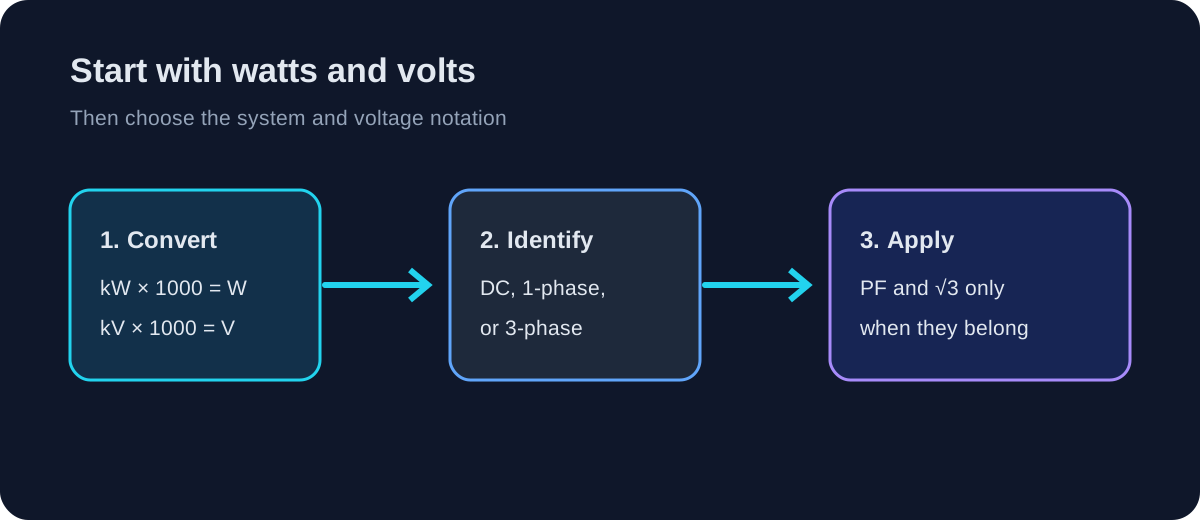
Convert kilowatts to watts before dividing: 1 kW is 1,000 W. A voltage written in kilovolts must likewise be converted to volts. This prevents a correct formula from producing a result that is wrong by a factor of 1,000.
DC uses I = P / V. Single-phase AC uses I = P / (V × PF). For three-phase AC, first identify whether the supplied voltage is line-to-line or line-to-neutral before choosing the denominator.
Three phase conductors are separated by 120 electrical degrees. In a balanced system, the vector relationship between phase voltage and line-to-line voltage produces VLL = √3 × VLN. Writing total real power as √3 × VLL × I × PF therefore gives the line current used by the L-L formula.
If the input is already line-to-neutral voltage, the phase power is repeated across three phases and the denominator is 3 × VLN × PF. Mixing VLL with the L-N denominator is a common source of a 1.732-times error.
Real power P, measured in watts, is the useful energy-transfer rate. Apparent power S, measured in volt-amperes, is V × I (or √3 × VLL × I in a balanced three-phase system). Power factor is P / S, so lower PF requires more current for the same real kW.
Reactive power Q, measured in var, oscillates between the source and inductive or capacitive fields. A current result based on real kW and PF does not tell you the waveform, harmonic current, inrush current, or unbalance current.
DC example: 5 kW at 240 V means 5,000 / 240 = 20.83 A.
Single-phase example: 5 kW at 240 V and PF 0.90 means 5,000 / (240 × 0.90) = 23.15 A.
Three-phase example: 10 kW at 415 V L-L and PF 0.85 means 10,000 / (√3 × 415 × 0.85) = 16.37 A per line.
The equations use real power in watts. Leaving a kW value unscaled makes the current 1,000 times too small.
Use 3 × VLN × PF only when the voltage input is measured from one phase to neutral. A line-to-line input belongs in the √3 formula.
No. PF describes the phase relationship between voltage and current. Motor efficiency separately converts shaft output power to electrical input power.
The calculation assumes the entered power, voltage, PF, and phase balance. Harmonics, unbalance, transients, and a different operating load can change measured current.