
The volts vs amps difference comes down to two separate electrical quantities. Volts measure electric potential difference, meaning the energy available per unit of charge. Amps measure current, meaning how much electric charge passes a point each second. Voltage can be present without current, but steady current needs a complete circuit through which charge can move.
That distinction matters whenever you read a charger label, choose a power supply, compare batteries, calculate appliance power, or investigate an overloaded circuit. Voltage helps determine whether a source is compatible with a device. Amperage describes the current being drawn or the maximum current a source or circuit can safely provide under stated conditions.
The two values are related, but neither can be converted into the other without additional information such as power, resistance, or impedance.
Volts vs Amps at a Glance
| Comparison point | Volts | Amps |
|---|---|---|
| Quantity measured | Electric potential difference | Electric current |
| Plain-language meaning | Energy available per unit charge | Charge passing a point per second |
| SI unit symbol | V | A |
| Common equation symbol | V or E | I |
| Formal relationship | 1 V = 1 J/C | 1 A = 1 C/s |
| Typical instrument | Voltmeter | Ammeter or clamp meter |
| How it is measured | Across two points | Through a circuit path |
| Can it exist in an open circuit? | Yes | No steady current through the open path |
| Practical use | Checking supply and device compatibility | Checking load demand and circuit capacity |
A volt answers, “How much energy is available to each unit of charge between these two points?”
An amp answers, “How much charge is passing this point every second?”
Watts add a third question: “How quickly is electrical energy being delivered or used?” For DC and simple resistive loads, power is calculated by multiplying volts by amps.
Begin With Electric Charge
Electricity becomes easier to understand when we follow electric charge through a basic circuit.
Imagine a battery connected to a lamp with two wires. The battery separates charge and creates an electric potential difference between its terminals. That potential difference is voltage. Once the circuit is closed, an electric field is established through the conducting path, and charge begins moving through the circuit. The rate of that movement is current.
The lamp is the load. It receives electrical energy and converts part of it into light and heat. The voltage tells us how much energy is transferred per unit of charge. The current tells us how much charge moves through the lamp per second.
This is more precise than saying that voltage is simply “pressure” or that amperage is the “amount of electricity.” Those descriptions can help beginners, but they leave out what the units actually measure.
A circuit therefore involves several linked ideas:
- A source creates a potential difference.
- A closed path allows current to flow.
- A load receives and converts electrical energy.
- Resistance or impedance affects the resulting current.
- Voltage and current together determine the rate of energy transfer.
Changing one part of the system can affect the others.
What a Volt Measures

The volt is the unit of electric potential difference. One volt equals one joule of energy per coulomb of charge:
1 V = 1 J/C
Suppose one coulomb of charge moves through a potential difference of 12 volts. In ideal terms, 12 joules of energy are transferred.
Voltage is always measured between two points. A statement such as “this point is at 12 volts” is incomplete unless a reference point is understood. In a battery system, voltage is normally measured between the positive and negative terminals. In a household circuit, it may be measured between line and neutral, line and line, or another defined pair of conductors.
Voltage can exist even when no useful current is flowing. A disconnected 12 V battery may still show close to its terminal voltage on a voltmeter. The open circuit prevents steady current from reaching a load, but the potential difference remains across the terminals.
This is why voltage should not be described as electricity already flowing. It represents the electrical potential that can drive current when a suitable path is available.
What One Ampere Represents
The ampere, usually shortened to amp, is the SI unit of electric current. Current measures the rate at which electric charge passes a point:
I = (Q) ÷ (t)
Where:
- (I) is current in amperes
- (Q) is charge in coulombs
- (t) is time in seconds
One ampere means one coulomb of charge passes a point each second:
1 A = 1 C/s
Current is not the number of electrons sitting inside a wire. Conductors already contain charge carriers. Current describes the rate at which charge moves as part of the circuit’s electrical response.
A device does not draw current merely because a supply has a high amp rating. The connected load, applied voltage, resistance, impedance, control electronics, and operating conditions determine the actual current.
For example, connecting a small device to a properly regulated 5 A power supply does not normally force 5 A through it. The 5 A rating usually describes the maximum current the supply is designed to provide. The device may draw only 0.5 A if that is what its circuitry requires.
This principle assumes that the voltage, connector, polarity, charging protocol, current-limiting behavior, and other specifications are compatible.
Resistance Connects Voltage and Current
Voltage and current are different, but they interact through the electrical characteristics of the load. For an ideal resistive circuit, Ohm’s law states:
V = I × R
Where:
- (V) is voltage in volts
- (I) is current in amperes
- (R) is resistance in ohms
To find current:
I = (V) ÷ (R)
Consider a 12 V source connected across a 6 Ω resistor:
I = (12) ÷ (6)
I = 2 A
If the resistance stays at 6 Ω and the voltage rises to 24 V:
I = (24) ÷ (6)
I = 4 A
Doubling the voltage doubled the current because the resistance remained constant.
Real equipment is not always a fixed resistor. Motors, transformers, LED drivers, chargers, computers, and other electronic loads may contain inductance, capacitance, switching controls, or active regulation. In AC systems, impedance and power factor can matter as well. Ohm’s law remains foundational, but a basic resistance value may not fully predict how such equipment behaves.
Our kW to amps formula explains the additional variables used for DC, single-phase AC, and three-phase calculations.
Why You Cannot Convert Volts Directly Into Amps

There is no fixed answer to questions such as “How many amps is 120 volts?” or “How many volts are in one amp?” Volts and amps measure different quantities.
To calculate current from voltage, you need at least one more relevant value.
If resistance is known:
I = (V) ÷ (R)
If power is known for a DC or resistive load:
I = (P) ÷ (V)
The same 120 V supply can power devices with very different current requirements. A 60 W resistive load draws:
I = (60) ÷ (120) = 0.5 A
A 1,200 W resistive load at the same voltage draws:
I = (1200) ÷ (120) = 10 A
Both loads receive 120 V, but the second draws twenty times as much current because it uses twenty times as much power.
For AC equipment, the calculation may also require power factor and the correct phase formula. Motors and compressors can have starting current that is much higher than normal running current. The equipment nameplate is therefore more useful than a generic volts-to-amps assumption.
For a focused example at another common supply level, see how to calculate amps at 220 volts.
Equal Power Can Use Different Voltage and Current
Electrical power for DC and simple resistive loads follows:
P = V × I
Two systems can deliver the same power with different combinations of voltage and current.
Consider these two 60 W examples:
12 V × 5 A = 60 W
24 V × 2.5 A = 60 W
Both deliver 60 watts. The first uses lower voltage and twice the current. The second uses higher voltage and half the current.
This distinction has practical consequences. Conductor heating is related to the square of current:
P_loss = I^2R
If conductor resistance stays the same, 5 A produces four times the resistive loss of 2.5 A:
(5^2) ÷ (2.5^2) = 4
This is one reason higher voltage is used to transmit large amounts of power. Raising voltage allows the same power to be transferred with less current, which can reduce resistive heating and voltage drop. Transformers and power-electronic converters are then used to change voltage levels where appropriate.
Higher voltage is not automatically “better,” however. It demands suitable insulation, clearances, components, connectors, and protection. The correct design balances voltage, current, power, efficiency, equipment cost, and safety.
Reading Charger, Battery, and Appliance Labels
Understanding volts vs amps becomes especially useful when a label shows several electrical ratings at once.
Power adapters and chargers
Suppose a laptop adapter lists this output:
- 20 V DC
- 3.25 A maximum
- 65 W
The power relationship is:
20 × 3.25 = 65 W
The laptop must support the adapter’s output voltage and charging method. The 3.25 A figure indicates the current available at that specified output mode, not a current that is forced through the laptop at all times.
A replacement supply with the wrong voltage can damage equipment or fail to operate it. A supply with a higher available current rating may be acceptable for many regulated devices because the load draws the current it needs, but only when voltage, polarity, connector, protocol, regulation, and manufacturer requirements also match.
USB-C and other modern charging systems can negotiate voltage and current levels electronically. Reading one printed number without considering the supported charging profiles may lead to an incorrect compatibility decision.
Batteries
Battery voltage describes the electrical potential of the battery system. Amp-hour capacity estimates how much charge the battery can deliver under specified conditions.
A 12 V, 100 Ah battery is not continuously delivering 100 A. The amp-hour rating is a capacity measurement involving current and time.
A simple nominal energy estimate is:
Wh = V × Ah
12 V × 100 Ah = 1200 Wh
Actual usable energy depends on battery chemistry, voltage variation, temperature, discharge rate, system losses, age, and operating limits.
Appliances and circuits
An appliance nameplate may list rated voltage, frequency, watts, amps, and phase. The rated voltage shows the intended supply. The current rating describes expected or maximum current under specified conditions.
A circuit’s breaker rating is different from appliance operating current. A device connected to a 20 A circuit does not automatically consume 20 A. The breaker and conductors provide and protect circuit capacity, while the load determines its current draw.
Use the kW to amps calculator when power and the necessary system values are known. To work in the other direction, you can convert amps to kilowatts.
How Voltage and Current Are Measured
Voltage and current require different measurement methods.
A voltmeter measures potential difference between two points, so it is connected across the component or source being tested. A digital multimeter set to voltage mode has high internal resistance, which limits how much current the meter draws during the measurement.
An ammeter measures current through a circuit path. A conventional current measurement requires the meter to become part of that path, meaning it is connected in series. The meter’s current input has very low resistance.
This difference creates an important safety rule: never place a multimeter set to current mode directly across a voltage source. Doing so can create a short circuit through the meter, blow its fuse, damage the instrument, cause an arc, or expose the user to injury.
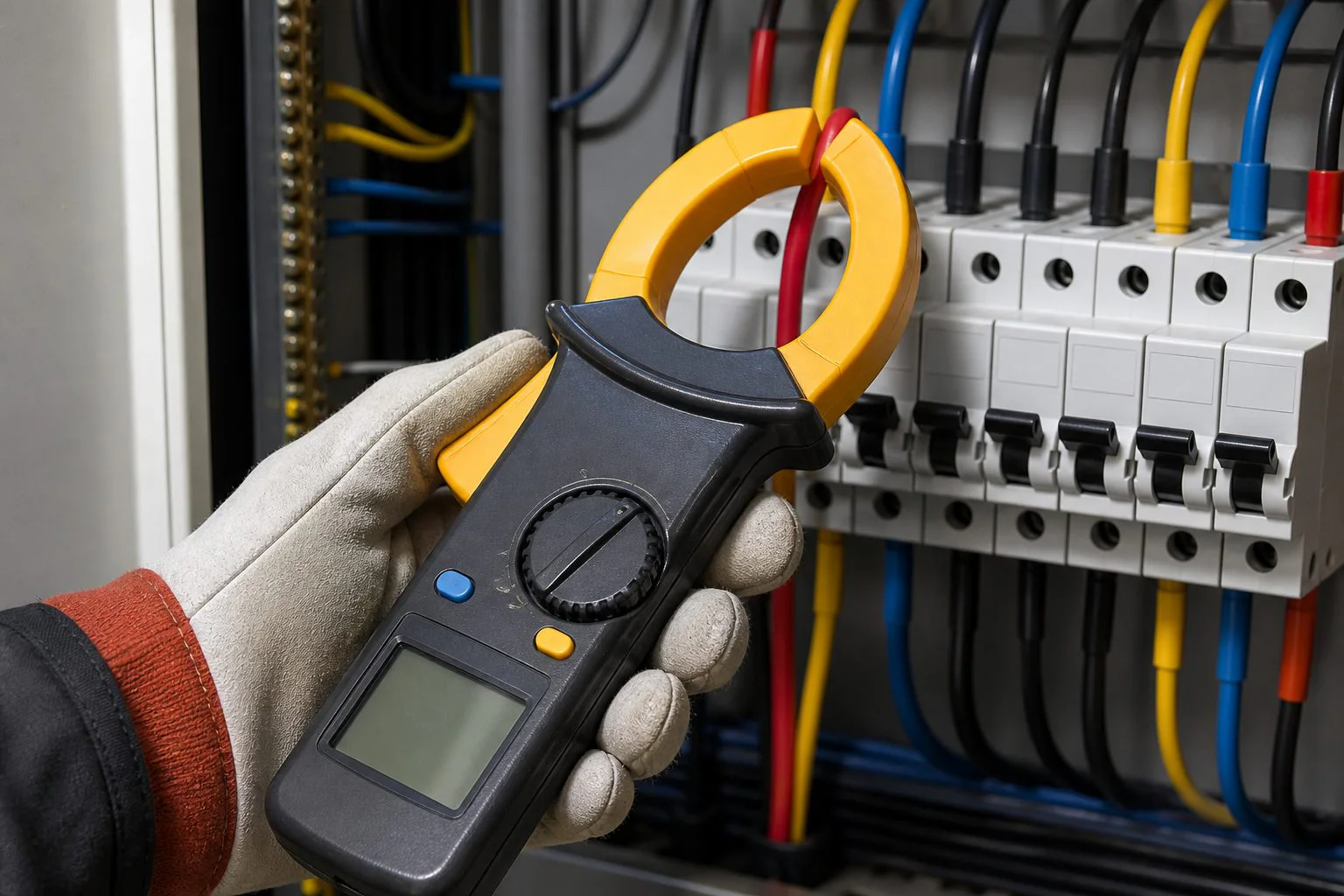
A clamp meter can measure current without opening the circuit by detecting the magnetic field around a conductor. For a meaningful reading, the clamp usually goes around one current-carrying conductor. Clamping around an entire cable containing both outgoing and return conductors can cause their magnetic fields to cancel.
Working inside a mains panel or on exposed energized conductors requires appropriate equipment, training, and procedures. If the measurement cannot be made safely from an accessible test point, use a qualified electrical professional.
The Water Analogy Helps, but Only Up to a Point
The familiar water analogy compares voltage to pressure, current to flow rate, and resistance to a restriction in a pipe. It can provide a useful first picture:
- Greater pressure can produce more flow through the same restriction.
- A tighter restriction reduces flow at the same pressure.
- Pressure may exist behind a closed valve even when no water flows.
Those comparisons resemble the basic relationship among voltage, current, and resistance.
The analogy becomes unreliable when stretched too far. Electrical energy does not move through a circuit exactly like water traveling through a hose. Electric and magnetic fields play a central role in energy transfer. AC voltage and current change direction, and components such as capacitors and inductors store energy in fields. Electronic loads can also adjust their behavior instead of acting like fixed pipe restrictions.
Use the analogy to build intuition, then return to the actual definitions: voltage is energy per unit charge, current is charge flow rate, and resistance or impedance affects their relationship.
Electrical Safety Involves Both Voltage and Current
The question “Do volts or amps cause electric shock?” has no responsible one-word answer.
Injury occurs when current passes through the body, but voltage provides the potential that can drive that current through body resistance. The outcome also depends on:
- the current path through the body
- contact duration
- AC frequency or DC conditions
- skin condition and moisture
- contact pressure and area
- source capability
- environmental conditions
- available protective devices
- how quickly the circuit is disconnected
A source can show high voltage but have tightly limited available current. Another source may combine hazardous voltage with enough current capacity to cause severe injury, burns, fire, or equipment damage.
Do not treat a low-looking voltage or amp rating as proof that experimentation is safe. Batteries can supply very high fault current, and damaged wiring or incorrect meter use can produce intense heating and arcing.
Before handling electrical equipment, disconnect and isolate its power where possible. Follow the manufacturer’s instructions and applicable electrical requirements. Work involving mains wiring, distribution panels, grounding, overcurrent protection, or uncertain conductors should be left to a qualified professional.
Frequently Asked Questions
Are volts and amps the same?
No. Volts measure electric potential difference, which is energy per unit charge. Amps measure current, which is the rate of charge flow. They describe different parts of an electrical system and cannot be treated as equivalent units.
Can volts be converted directly to amps?
No. You need another value. If resistance is known, use (I = V/R). If power is known for a DC or resistive load, use (I = P/V). AC calculations may also require power factor, phase information, or impedance.
How many volts are in one amp?
There is no fixed number of volts in one amp. One amp flows through a resistance of one ohm when one volt is applied, but changing the resistance changes the voltage required for the same current.
Does a device draw only the amps it needs?
A compatible regulated device generally draws current according to its load and design. A supply’s amp rating usually indicates its available capacity. Correct voltage, polarity, connector, regulation, charging protocol, and manufacturer specifications must still be confirmed.
Is higher voltage better than higher amperage?
Neither is universally better. At equal power, higher voltage can allow lower current and reduce conductor losses. Higher voltage also requires suitable insulation and components. The correct combination depends on the equipment, transmission distance, design, and safety requirements.
What is the difference between amps and amp-hours?
Amps measure current at a moment in time. Amp-hours describe charge capacity over time. A 100 Ah battery is not necessarily producing 100 A; it has a nominal capacity based on how current and time are combined under specified test conditions.
Why do chargers show both volts and amps?
The voltage rating identifies an output level or supported charging mode. The amp rating identifies the current available at that mode. Together they indicate potential power because watts equal volts multiplied by amps under the applicable conditions.
Which is more dangerous, volts or amps?
Electrical risk involves both. Voltage drives current through the body, while current through the body causes physiological effects and heating. Severity also depends on path, duration, frequency, resistance, skin condition, source capacity, and the environment.
Keep the Two Questions Separate
The simplest way to remember volts vs amps is to ask two different questions. Voltage tells you how much energy is available per unit of charge between two points. Amperage tells you how much charge passes through the circuit each second.
Neither value tells the whole story by itself. Check voltage for compatibility, current for load and circuit demands, and watts for the resulting power. When calculations affect wiring, protection, or safe equipment use, rely on the nameplate, manufacturer documentation, and a properly qualified professional.