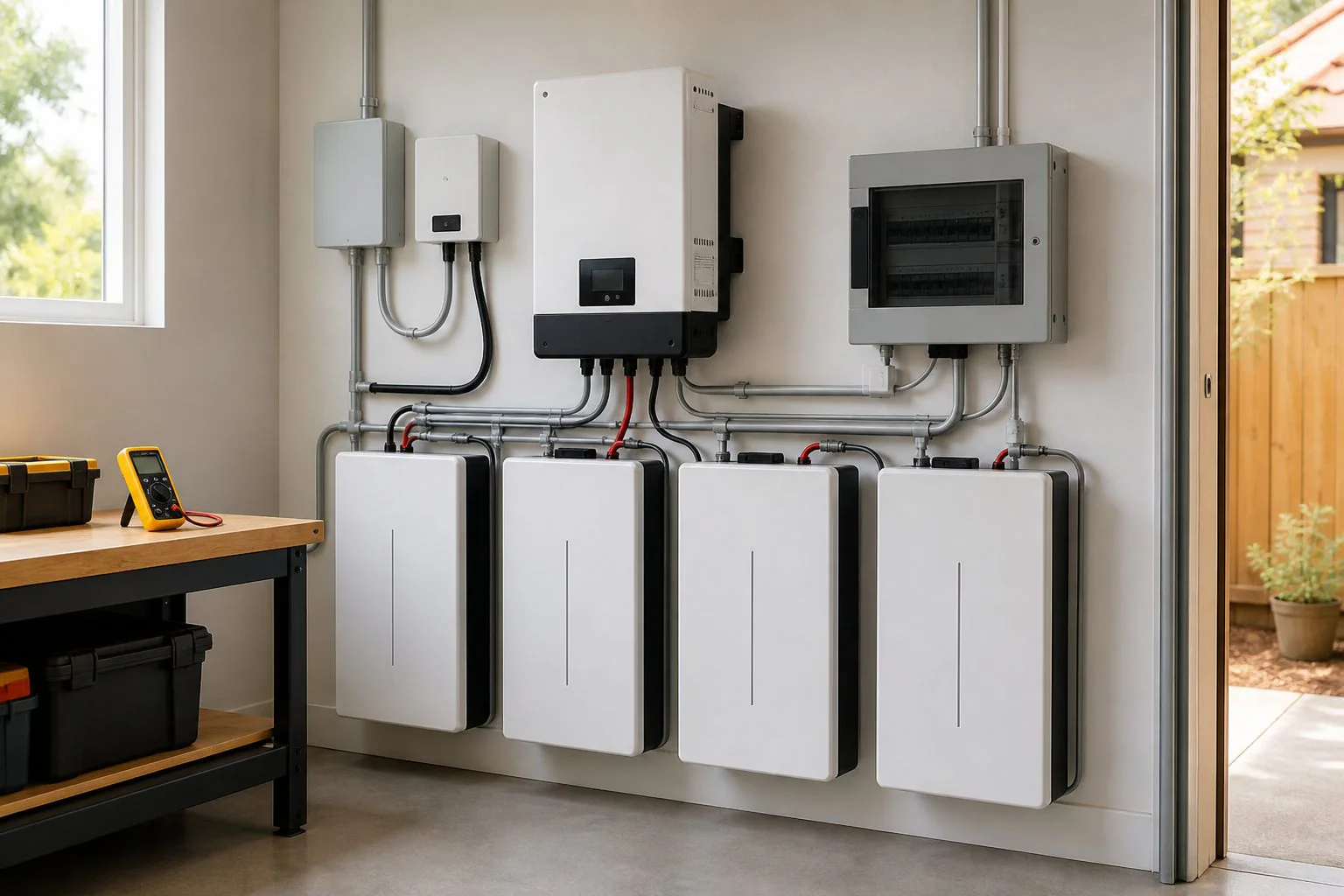
A Battery kWh calculator converts a battery’s voltage and amp-hour rating into kilowatt-hours, giving you a clearer picture of how much energy it can store. The basic formula is straightforward: multiply volts by amp-hours, then divide by 1,000.
A 12V 100Ah battery stores 1.2 kWh of nominal energy, while a 48V 100Ah battery stores 4.8 kWh. Their amp-hour ratings are identical, but the higher-voltage battery holds four times as much energy.
Nominal capacity is only the first part of a useful calculation. If you are sizing solar storage, planning home backup, or estimating battery runtime, you should also consider depth of discharge, inverter efficiency, temperature, battery age, and reserve capacity. Peak power and battery-management-system limits must be checked separately because kWh measures energy, not how quickly that energy can be delivered.
Quick Calculation
Use this formula to calculate battery energy:
Battery kWh = (Voltage × Amp-hours) ÷ 1,000
For a 51.2V 100Ah battery:
Battery kWh = (51.2 × 100) ÷ 1,000
Battery kWh = 5.12 kWh
To estimate energy available to an AC load:
Usable AC energy = Nominal kWh × permitted DoD × inverter efficiency
At 80% depth of discharge and 92% inverter efficiency:
5.12 × 0.80 × 0.92 = 3.77 kWh
The battery is still rated at 5.12 kWh, but approximately 3.77 kWh reaches the AC load under those assumptions.
How to Use a Battery kWh Calculator
A basic calculator needs two inputs:
- Battery voltage in volts
- Battery capacity in amp-hours
Enter the nominal voltage shown on the battery specification sheet, followed by its Ah rating. The result is nominal energy in kilowatt-hours.
For example, consider a 24V 200Ah battery bank:
kWh = (200 Ah × 24 V) ÷ 1,000
kWh = 4.8 kWh
For a more realistic battery energy calculation, add the permitted depth of discharge and one-way system efficiency:
Load-side usable kWh = nominal kWh × DoD × efficiency
Suppose the 4.8 kWh bank can use 80% of its capacity and supplies an AC load through an inverter operating at an estimated 90% efficiency:
Usable kWh = 4.8 × 0.80 × 0.90
Usable kWh = 3.456 kWh
Round the result appropriately—about 3.46 kWh in this case. Do not present more decimal places than the input data can support.
Understanding kWh, Ah, Voltage, and Power

Battery labels often mix units that describe different electrical properties.
An amp-hour, abbreviated Ah, measures electrical charge. It indicates how much current a battery can theoretically provide over time under stated test conditions. One amp-hour equals 3,600 coulombs, according to the NIST Guide to the SI.
A watt-hour, or Wh, measures electrical energy. It combines voltage, current, and time:
Wh = V × Ah
A kilowatt-hour, or kWh, equals 1,000 watt-hours:
kWh = Wh ÷ 1,000
A kilowatt, or kW, measures power rather than stored energy. Power describes the rate at which energy is being used. A constant 1 kW load consumes 1 kWh in one hour, 2 kWh in two hours, and 5 kWh in five hours.
This distinction matters because a battery may contain enough energy for a load but still be unable to supply its peak power. Battery kWh, inverter output, BMS current limits, discharge rate, and surge requirements all need to be compatible.
Ah-to-kWh Conversion Chart
This battery capacity chart shows nominal energy before accounting for depth of discharge or conversion losses.
| Battery rating | Nominal energy |
|---|---|
| 12V 50Ah | 0.60 kWh |
| 12V 100Ah | 1.20 kWh |
| 12V 200Ah | 2.40 kWh |
| 12V 300Ah | 3.60 kWh |
| 24V 100Ah | 2.40 kWh |
| 24V 200Ah | 4.80 kWh |
| 36V 100Ah | 3.60 kWh |
| 48V 100Ah | 4.80 kWh |
| 48V 200Ah | 9.60 kWh |
| 51.2V 100Ah | 5.12 kWh |
| 51.2V 200Ah | 10.24 kWh |
The table reveals why Ah alone is not a reliable way to compare batteries operating at different voltages.
A 12V 200Ah battery and a 24V 100Ah battery both store approximately 2.4 kWh. The first has twice the amp-hour rating, but the second has twice the voltage. Their nominal energy is the same.
Likewise, a 48V 100Ah battery stores four times the energy of a 12V 100Ah battery, even though both labels show 100Ah.
Nominal Capacity, Usable Capacity, and Delivered Energy
These three values are related but should not be treated as interchangeable.
Nominal capacity is the nameplate energy calculated from rated voltage and amp-hours. A 48V 100Ah battery has a nominal capacity of 4.8 kWh.
Battery-side usable capacity is the portion permitted within the chosen operating window:
Battery-side usable kWh = nominal kWh × permitted DoD
If the 4.8 kWh battery is operated to 80% depth of discharge:
4.8 × 0.80 = 3.84 kWh
Delivered energy accounts for losses between the battery and the load:
Delivered kWh = nominal kWh × DoD × one-way efficiency
At 92% inverter efficiency:
4.8 × 0.80 × 0.92 = 3.53 kWh
Round-trip efficiency is a different measure. It compares energy recovered from a storage system with the energy used to charge it through a complete charge-discharge cycle. For a simple runtime estimate from an already charged battery, one-way discharge-path or inverter efficiency is generally the more relevant input.
Do not assume a universal DoD or efficiency based solely on battery chemistry. Use the limits and performance information supplied by the battery and inverter manufacturers.
Calculating the Battery Size You Need
A battery size calculator works backward from the energy your loads require.
First, determine usable energy:
Required usable kWh = average load in kW × runtime in hours
Then account for the permitted DoD and system efficiency:
Minimum nominal kWh = required usable kWh ÷ (DoD × efficiency)
Imagine that essential appliances draw an average of 800 W, or 0.8 kW, and must run for eight hours:
Required usable energy = 0.8 kW × 8 h
Required usable energy = 6.4 kWh
If the system uses 80% depth of discharge and has an estimated 90% delivery efficiency:
Minimum nominal capacity = 6.4 ÷ (0.80 × 0.90)
Minimum nominal capacity = 8.89 kWh
A system designed to meet this target should provide at least 8.89 kWh of nominal storage under the stated assumptions. In practice, you would round up to available battery-module sizes and may include additional capacity for aging, cold weather, load growth, or reserve operation.
Build the load estimate carefully
Average load should come from the appliances that will actually operate during the backup period. For each device:
Energy in kWh = watts × operating hours ÷ 1,000
Suppose the planned backup loads are:
| Load | Power | Operating time | Energy |
|---|---|---|---|
| Refrigerator average | 150 W | 8 h | 1.20 kWh |
| Lights | 100 W | 5 h | 0.50 kWh |
| Internet equipment | 30 W | 8 h | 0.24 kWh |
| Television | 120 W | 3 h | 0.36 kWh |
| Fans | 160 W | 6 h | 0.96 kWh |
| Other small loads | 100 W | 4 h | 0.40 kWh |
| Total | 3.66 kWh |
At 80% DoD and 90% efficiency:
Nominal capacity = 3.66 ÷ (0.80 × 0.90)
Nominal capacity ≈ 5.08 kWh
The calculation provides a first-pass home battery capacity. Starting surges, inverter idle consumption, changing appliance duty cycles, and future degradation still need separate attention.
Estimating Battery Runtime

A battery runtime calculator compares usable energy with average load power:
Runtime in hours = delivered battery energy in kWh ÷ load in kW
Consider a 10.24 kWh battery with an 80% operating window and 92% inverter efficiency:
Delivered energy = 10.24 × 0.80 × 0.92
Delivered energy ≈ 7.54 kWh
If the average load is 1.2 kW:
Runtime = 7.54 ÷ 1.2
Runtime ≈ 6.28 hours
That figure is an estimate, not a promised operating time. Real load power often changes from minute to minute. Refrigerators cycle, pumps start and stop, heating equipment responds to temperature, and inverter efficiency varies with load.
For better estimates, include the inverter’s own consumption. If the appliances average 1.2 kW and the inverter uses 40 W while operating, calculate with a total average demand of 1.24 kW:
Runtime = 7.54 ÷ 1.24 ≈ 6.08 hours
The gap looks small in this example, but idle consumption becomes more noticeable when the appliance load is light or the backup period is long.
Sizing a Solar or Home-Backup Battery
A solar battery calculator must answer a different question from a simple Ah-to-kWh converter. It needs to determine how much energy should be stored for a chosen operating goal.
Useful inputs include:
- electricity consumption during the backup window
- required backup duration
- loads that must remain available
- allowable depth of discharge
- expected system efficiency
- solar production during the period
- reserve energy
- seasonal conditions
- allowable grid charging
- battery aging allowance
For nighttime solar use, calculate the energy consumed after solar production falls below demand. Do not automatically use the property’s full 24-hour consumption if daytime loads are supplied directly by the solar array.
For outage protection, decide which loads are essential. Backing up refrigeration, lights, communications, and a few outlets requires far less battery storage than operating electric heating, air conditioning, cooking appliances, water heating, and EV charging.
For off-grid battery sizing, autonomy is particularly important. If daily consumption is 8 kWh and the system must operate for two days without useful solar production:
Required usable energy = 8 × 2 = 16 kWh
At 80% DoD and 90% delivery efficiency:
Minimum nominal energy = 16 ÷ (0.80 × 0.90)
Minimum nominal energy ≈ 22.22 kWh
Solar-array size, charge-controller capacity, inverter limits, seasonal production, and maximum charge current must be checked alongside storage capacity. A large battery that cannot be recharged within the available solar window may not perform as expected.
How Many Batteries Do You Need?
Once the minimum nominal capacity is known, divide it by the energy capacity of one battery module and round up:
Battery quantity = required nominal kWh ÷ module kWh
Suppose the system requires at least 22.22 kWh, and each module is rated at 5.12 kWh:
Battery quantity = 22.22 ÷ 5.12
Battery quantity = 4.34
You cannot install 4.34 modules, so round up to five:
Installed capacity = 5 × 5.12 = 25.6 kWh
At the assumed 80% DoD and 90% efficiency:
Delivered capacity = 25.6 × 0.80 × 0.90
Delivered capacity = 18.43 kWh
This exceeds the 16 kWh usable-energy requirement.
The energy count does not establish a safe series-parallel configuration. Final design must also confirm compatible module voltage, inverter voltage window, BMS communication, charge and discharge current, overcurrent protection, cable sizing, fault-current capability, isolation, and manufacturer-approved configurations.
Series and Parallel Battery Connections
Connecting identical batteries in series adds voltage while the amp-hour rating remains the same.
Two 12V 100Ah batteries in series create a nominal 24V 100Ah bank:
24 × 100 ÷ 1,000 = 2.4 kWh
Connecting identical batteries in parallel keeps voltage the same while amp-hours add.
Two 12V 100Ah batteries in parallel create a nominal 12V 200Ah bank:
12 × 200 ÷ 1,000 = 2.4 kWh
Both arrangements use two identical batteries, so both have the same nominal energy. What changes is system voltage and current behavior.
Higher system voltage can deliver the same power with less current, but that does not make arbitrary series connections acceptable. Batteries, BMS units, chargers, and inverters must support the intended configuration.
Battery Chemistry Changes Usable Performance
The basic energy equation does not change with chemistry:
kWh = (Ah × V) ÷ 1,000
Chemistry does, however, affect nominal voltage, discharge behavior, recommended operating window, efficiency, temperature performance, cycle life, and charging requirements.
Lithium-ion and LiFePO4 batteries often maintain voltage differently across discharge than lead-acid batteries. Lead-acid battery capacity is also more sensitive to discharge rate. At higher currents, its effective capacity can fall below the nominal Ah rating measured under a slower test.
Victron’s documentation explains that effective battery capacity can depend on discharge rate, temperature, and charge efficiency. Its discussion of battery capacity and the Peukert exponent illustrates why a nameplate Ah figure may not predict actual performance under every load.
Avoid assigning one fixed usable percentage to every lithium, LiFePO4, AGM, or lead-acid battery. Follow the manufacturer’s limits for the specific model, intended cycle life, temperature range, and application.
What a kWh Result Does Not Tell You

Energy capacity is only one part of selecting a battery system.
A 10 kWh battery may contain enough energy to operate a 2 kW average load for several hours, yet it might not support a 10 kW startup surge. You must also check:
- maximum continuous discharge power
- short-duration peak power
- BMS current limit
- recommended C-rate
- inverter surge rating
- low-temperature charging restrictions
- maximum charge current
- cycle-life conditions
- communication compatibility
- required protection and disconnects
C-rate describes charge or discharge current relative to capacity. For a 100Ah battery, 1C corresponds to 100 A, while 0.5C corresponds to 50 A. The permitted rate depends on the particular cell and battery design.
Energy answers “how much.” Power and current limits answer “how fast.” A sound battery-bank design needs both.
Common Battery Calculation Errors
A frequent mistake is comparing Ah ratings without checking voltage. A 48V 100Ah battery stores much more energy than a 12V 100Ah battery.
Other errors include treating nominal kWh as fully usable, applying round-trip efficiency to the wrong calculation, and forgetting the inverter’s own energy consumption.
Load calculations can also be misleading when every appliance is assumed to run continuously. Use realistic duty cycles, but keep a separate check for the maximum simultaneous and surge load.
Battery quantity should always be rounded up. Four modules cannot meet a requirement of 4.34 modules, even if the result appears close.
Finally, do not treat an energy-level estimate as a finished electrical design. Battery current, protective devices, conductor sizing, grounding, enclosure requirements, fault behavior, equipment listings, and local rules require qualified evaluation.
Frequently Asked Questions
How is battery kWh calculated?
Multiply the battery’s nominal voltage by its amp-hour rating, then divide by 1,000: kWh = (Ah × V) ÷ 1,000. A 48V 100Ah battery therefore stores 4.8 kWh of nominal energy. Usable energy may be lower after applying the permitted depth of discharge and system losses.
How many kWh is a 12V 100Ah battery?
A 12V 100Ah battery has a nominal energy capacity of 1.2 kWh because 12 × 100 ÷ 1,000 = 1.2. That does not mean the full 1.2 kWh should always be discharged. Use the manufacturer’s operating limits to estimate usable capacity.
How many kWh is a 48V 100Ah battery?
A 48V 100Ah battery stores approximately 4.8 kWh of nominal energy. If it is rated at 51.2 V rather than 48 V, the result is 5.12 kWh. Use the exact nominal voltage on the manufacturer’s specification sheet.
What is the difference between Ah and kWh?
Ah measures electrical charge, while kWh measures electrical energy. An Ah rating cannot describe total stored energy without voltage. Batteries with the same Ah rating can have very different kWh capacities if their voltages differ.
How does depth of discharge affect battery size?
A lower permitted depth of discharge means more nominal capacity is required to deliver the same usable energy. If a load needs 8 kWh and only 80% of the battery is used, at least 10 kWh is required before accounting for inverter or other system losses.
How do I calculate battery runtime in hours?
First calculate delivered energy by multiplying nominal kWh by the permitted DoD and applicable one-way efficiency. Then divide that energy by the average load in kW. A battery delivering 6 kWh to a constant 1.5 kW load has an estimated runtime of four hours.
Does battery chemistry change the kWh calculation?
No. The basic voltage-times-Ah formula remains the same. Chemistry can change the nominal voltage, useful operating window, discharge-rate behavior, efficiency, temperature response, and recommended limits, all of which affect practical usable energy and runtime.
Why is actual battery runtime lower than the calculated runtime?
Real systems experience inverter and wiring losses, changing loads, voltage variation, temperature effects, discharge-rate effects, standby consumption, aging, and BMS cutoffs. A simple calculation usually starts with fixed nominal values, so its result should be treated as an estimate.
Calculate the Requirement Before Choosing the Battery
A Battery kWh calculator is most useful when it does more than convert Ah and volts. Start with nominal energy, then calculate the usable portion, expected delivered energy, runtime, and module count for the way the system will actually operate.
Use manufacturer data for voltage, depth of discharge, efficiency, temperature limits, and current ratings. For a solar, off-grid, or whole-home installation, confirm the energy estimate against inverter limits, BMS requirements, protection, wiring, and a qualified system design.