kW to Amps Logo
kW to Amps
3-Phase Systems

kW to Amps 3 Phase Calculator

Convert kilowatts to amps for three-phase electrical systems. Supports Line-to-Line and Line-to-Neutral voltage configurations.

3-Phase Calculator

Enter power and voltage to calculate current

Decimals:
4
Current Result
16.3671
Amps (A)

Formula: I = 10000 / (√3 × 415 × 0.85) = 16.3671 A

3-Phase Conversion Table

Line-to-Line voltage at PF = 0.85

Power (kW) 380V400V415V440V480V
1 kW 1.79 A1.70 A1.64 A1.54 A1.42 A
2 kW 3.57 A3.40 A3.27 A3.09 A2.83 A
3 kW 5.36 A5.09 A4.91 A4.63 A4.25 A
5 kW 8.94 A8.49 A8.18 A7.72 A7.08 A
7.5 kW 13.41 A12.74 A12.28 A11.58 A10.61 A
10 kW 17.87 A16.98 A16.37 A15.44 A14.15 A
15 kW 26.81 A25.47 A24.55 A23.16 A21.23 A
20 kW 35.75 A33.96 A32.73 A30.87 A28.30 A
25 kW 44.69 A42.45 A40.92 A38.59 A35.38 A
30 kW 53.62 A50.94 A49.10 A46.31 A42.45 A
50 kW 89.37 A84.90 A81.84 A77.19 A70.75 A
75 kW 134.06 A127.36 A122.75 A115.78 A106.13 A
100 kW 178.75 A169.81 A163.67 A154.37 A141.51 A

Understanding Three-Phase Power

Line-to-Line vs Line-to-Neutral

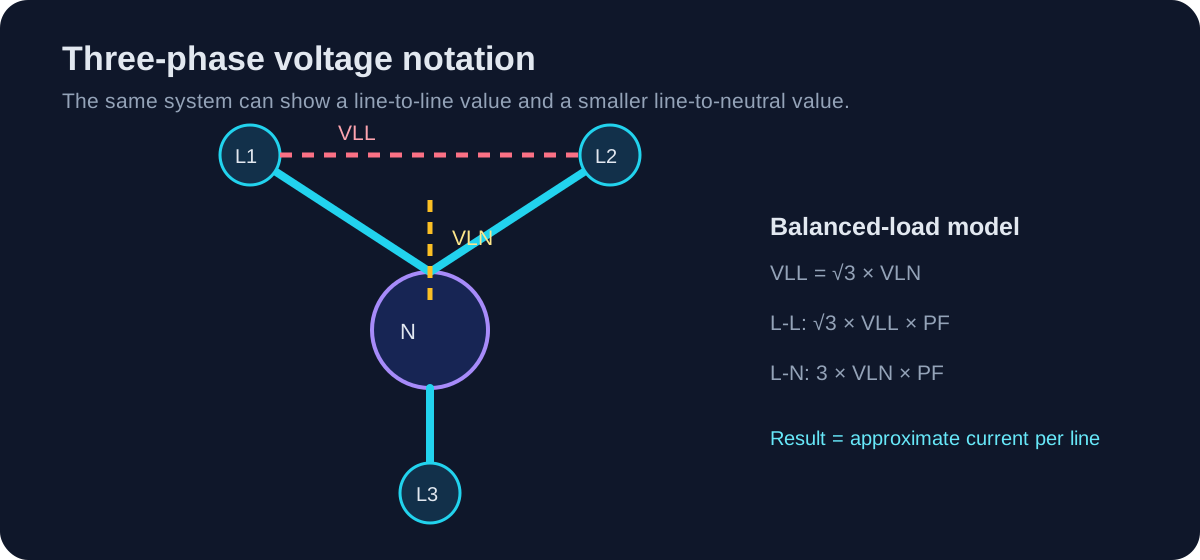
In a three-phase system, Line-to-Line voltage is measured between any two phases, while Line-to-Neutral is measured from one phase to the neutral point.

The relationship between them is: VLL = √3 × VLN

Common Applications

  • Industrial motors and machinery
  • Commercial HVAC systems
  • Large pumps and compressors
  • Data centers and server rooms
Calculator

Main Calculator

Full kW to Amps converter

Learn

Formula Guide

Complete formula breakdown

Single Phase

Single Phase Guide

Single-phase conversion

Page intent

Use this page when a nameplate or switchboard shows 400 V, 415 V, 440 V, or 480 V three-phase values and you need to identify the correct voltage notation and the per-line current.

Three-phase diagram labelling line-to-line and line-to-neutral voltage and per-line current

Line-to-line versus line-to-neutral

A 415 V L-L label is the voltage measured between two phase conductors. A roughly 240 V L-N label is measured from one phase to neutral in the same nominal system. They are related by VLL ≈ √3 × VLN for a balanced sine-wave system.

For 10 kW at 415 V L-L and PF 0.85, current is 16.37 A per line. If 240 V is genuinely an L-N input for the same load, the L-N equation gives 16.34 A per line.

Compare 400 V, 415 V, 440 V, and 480 V systems

At PF 0.85, 15 kW draws 25.47 A at 400 V L-L, 24.55 A at 415 V, 23.16 A at 440 V, and 21.23 A at 480 V.

These values are line current under the same balanced-load assumption. They do not mean every conductor, neutral, protective device, or motor terminal experiences identical conditions in an unbalanced or nonlinear installation.

Balanced-load assumption and phase imbalance

The √3 equation assumes the three phase currents are balanced and the waveform is sufficiently sinusoidal. An uneven mix of single-phase loads can raise one phase current while reducing another; triplen harmonics from nonlinear loads can also accumulate in the neutral.

For motors, pumps, compressors, and heaters, the result is a planning estimate of per-line current. Commissioning measurements, phase sequence, voltage imbalance, and manufacturer limits remain decisive.

Why three phase carries more power at lower current

Three phase delivers power continuously across three displaced waveforms. The √3 relationship lets a balanced three-phase system transfer the same real kW with lower line current than a single-phase system at the same voltage magnitude, which helps distribution efficiency and motor torque production.

Always label the voltage as L-L or L-N next to a result; the number alone is not enough context.

Continue with the right context

Page-specific FAQs

Is the three-phase result the current on each line?

For a balanced three-phase load, the calculator result is the approximate current in each line conductor.

Can I put 415 V into the L-N option?

Only if 415 V is actually measured from line to neutral. In many systems 415 V is the L-L value and the L-N value is lower.

Why does the L-N formula use 3 instead of √3?

When the supplied voltage is phase-to-neutral, the total real power is three times VLN × I × PF, so the denominator is 3 × VLN × PF.

What happens when phases are unbalanced?

One or more line currents can exceed the balanced estimate, and neutral current may rise. Use phase-by-phase measurements for an existing installation.

Does a three-phase heater have PF 1.0?

A resistive heater is often near PF 1.0, but contactors, controls, electronic controllers, and harmonics can change the measured current waveform.