kW to Amps Logo
kW to Amps
Single Phase

kW to Amps Single Phase Calculator

Convert kilowatts to amps for single-phase electrical systems. Perfect for residential and light commercial applications.

Single Phase Calculator

Enter power and voltage to calculate current

Decimals:
4

For resistive loads (heaters, lights) use PF = 1.0. For motors, use 0.8-0.9.

Current Result
23.1481
Amps (A)

Formula: I = 5000 / (240 × 0.9) = 23.1481 A

Single Phase Conversion Table

Power Factor = 0.9 (typical for mixed loads)

Power (kW) 110V120V220V230V240V
0.5 kW 5.05 A4.63 A2.53 A2.42 A2.31 A
1 kW 10.10 A9.26 A5.05 A4.83 A4.63 A
1.5 kW 15.15 A13.89 A7.58 A7.25 A6.94 A
2 kW 20.20 A18.52 A10.10 A9.66 A9.26 A
2.5 kW 25.25 A23.15 A12.63 A12.08 A11.57 A
3 kW 30.30 A27.78 A15.15 A14.49 A13.89 A
4 kW 40.40 A37.04 A20.20 A19.32 A18.52 A
5 kW 50.51 A46.30 A25.25 A24.15 A23.15 A
6 kW 60.61 A55.56 A30.30 A28.99 A27.78 A
7.5 kW 75.76 A69.44 A37.88 A36.23 A34.72 A
10 kW 101.01 A92.59 A50.51 A48.31 A46.30 A
15 kW 151.52 A138.89 A75.76 A72.46 A69.44 A

Understanding Single Phase Power

What is Single Phase?

Single-phase power uses two wires (live and neutral) to deliver electrical power. It's the most common form of electricity distribution for homes and small businesses.

In North America, standard residential outlets provide 120V single-phase, while larger appliances use 240V. In Europe, Australia, and most other regions, 220-240V is standard.

Power Factor Explained

Power factor measures how efficiently electrical power is being used. It ranges from 0 to 1, where 1 means 100% efficiency.

  • PF = 1.0: Resistive loads (heaters, incandescent lights)
  • PF = 0.9-0.95: LED lighting, modern appliances
  • PF = 0.8-0.9: Motors, air conditioners
Calculator

Main Calculator

Full kW to Amps converter

Learn

Formula Guide

Complete formula breakdown

3-Phase

3-Phase Calculator

Three-phase conversion

Page intent

This guide is for choosing a realistic single-phase assumption when the supply may be 120 V, 220 V, 230 V, or 240 V. The voltage printed on the equipment nameplate and measured at the installation matters more than a country label.

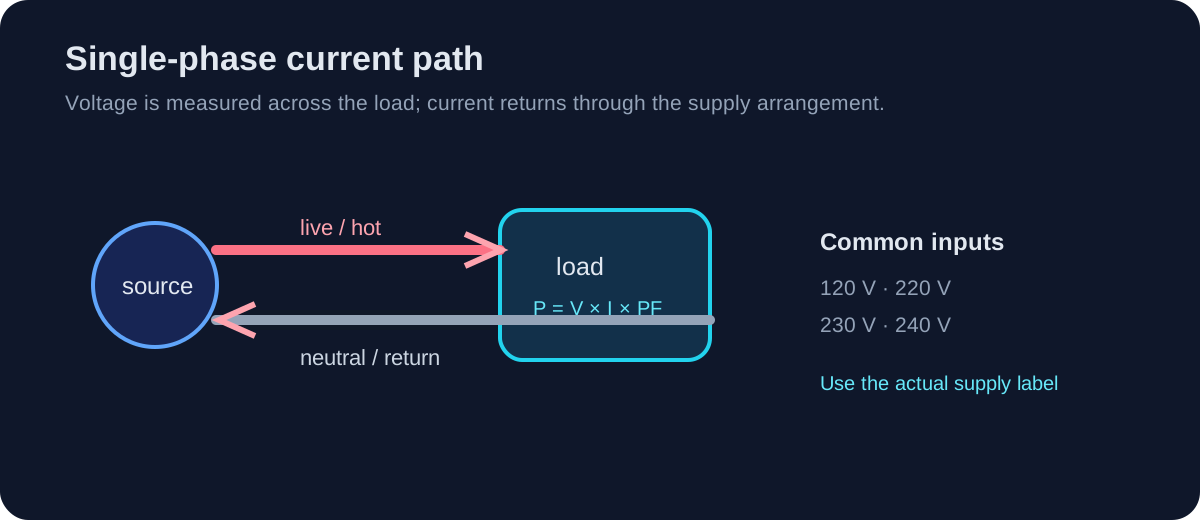
Single-phase source showing live, neutral, load voltage, and current path

Compare the same load at common single-phase voltages

For a 2 kW resistive load at PF 1.0, 120 V draws 16.67 A, 220 V draws 9.09 A, 230 V draws 8.70 A, and 240 V draws 8.33 A.

The higher-voltage supply carries the same real power at lower current. That does not make a 240 V appliance interchangeable with a 120 V appliance: insulation, heating elements, controls, plugs, and protective devices must all be compatible.

Resistive and inductive loads behave differently

A heater, kettle, or immersion element is close to resistive, so PF is often near 1.0 while it is energized. A refrigerator compressor, air-conditioner, pump, or workshop motor is inductive; its PF varies with load and its starting current can be far above the steady-state estimate.

Power-electronic loads such as LED drivers, chargers, and inverters may have active PF correction but can still draw non-sinusoidal current. The calculator estimates fundamental real-power current; it does not model harmonic RMS current.

Why neutral and supply configuration matter

Single-phase current normally flows out on the live conductor and returns on the neutral. In a split-phase or multiwire arrangement, the two hot conductors may be 180 degrees apart and the neutral carries only the imbalance when the loads are arranged correctly.

Do not infer the neutral current, earthing arrangement, or permissible circuit loading from a kW-to-amps result alone. Confirm the actual supply topology, conductor arrangement, and nameplate instructions.

When single-phase becomes impractical

A large continuous load can require current that is inconvenient for a domestic or small-commercial service. For example, 8 kW at 230 V and PF 0.9 is about 38.65 A; the service, connector, voltage drop, and local continuous-load rules may make a three-phase arrangement more appropriate.

Use the actual measured voltage and the equipment PF where available. Voltages listed here are common examples, not universal country-wide rules.

Continue with the right context

Page-specific FAQs

Why does the same kW load draw less current at 240 V than at 120 V?

For the same PF, current is inversely proportional to voltage. Doubling voltage approximately halves current, assuming the load really delivers the same kW.

Should I use PF 1.0 for a household appliance?

Use PF 1.0 for a near-resistive element. Motors, compressors, and electronic power supplies need their measured or nameplate PF instead.

Does a neutral always carry the full load current?

In a simple single-phase circuit it is the return path, but in split-phase or multiwire arrangements neutral current depends on load balance and conductor arrangement.

Can a 230 V result be used to size a 240 V circuit?

Use the actual supply voltage and local design rules. A small voltage difference changes the calculated current, and equipment ratings, voltage drop, and protection still need separate checks.

When should a load be moved to three phase?

When continuous current, voltage drop, service capacity, or equipment availability makes a single-phase connection impractical. That is an installation decision, not a calculator-only decision.