kW to Amps Logo
kW to Amps
Amps to kW

Amps to kW Calculator

Convert amperes to kilowatts for DC, single-phase, and three-phase electrical systems.

Calculate power from current

Enter current and voltage to calculate power

Decimals:
4
Power Result
4.32
Kilowatts (kW)

Formula: P = 20 × 240 × 0.9 / 1000 = 4.32 kW

Quick Reference: Amps to kW

Single-phase: PF 0.9 | Three-phase: PF 0.85, Line-to-Line voltage

AC single-phase

Current (Amps) 120V 220V 240V
5 A 0.54 kW 0.99 kW 1.08 kW
10 A 1.08 kW 1.98 kW 2.16 kW
15 A 1.62 kW 2.97 kW 3.24 kW
20 A 2.16 kW 3.96 kW 4.32 kW
25 A 2.70 kW 4.95 kW 5.40 kW
30 A 3.24 kW 5.94 kW 6.48 kW
40 A 4.32 kW 7.92 kW 8.64 kW
50 A 5.40 kW 9.90 kW 10.80 kW
100 A 10.80 kW 19.80 kW 21.60 kW

AC three-phase (L-L)

Current (Amps) 415V 440V 480V
5 A 3.05 kW 3.24 kW 3.53 kW
10 A 6.11 kW 6.48 kW 7.07 kW
15 A 9.16 kW 9.72 kW 10.60 kW
20 A 12.22 kW 12.96 kW 14.13 kW
25 A 15.27 kW 16.19 kW 17.67 kW
30 A 18.33 kW 19.43 kW 21.20 kW
40 A 24.44 kW 25.91 kW 28.27 kW
50 A 30.55 kW 32.39 kW 35.33 kW
100 A 61.10 kW 64.78 kW 70.67 kW

Understanding Amps to kW Conversion

The relationship between current and power

Power (kW) is the rate at which electrical energy is consumed or produced. To find power from current, you need to know the voltage and, for AC systems, the power factor.

  • Amps (A) = Current flow
  • Volts (V) = Electrical pressure
  • kW = Power (1 kW = 1000 W)

Common Applications

  • Sizing circuit breakers and wiring
  • Calculating electricity costs
  • Generator and inverter sizing
  • Solar panel system design
  • Motor power consumption
Calculator

kW to Amps

Convert kilowatts to amps

Formula

Formula Guide

Complete formula breakdown

Chart

Conversion Chart

Full tables + motor chart

Page intent

Use this page after a clamp-meter reading or when checking a nameplate current. Current alone is not enough: voltage, phase arrangement, PF, and the operating state determine the estimated real kW.

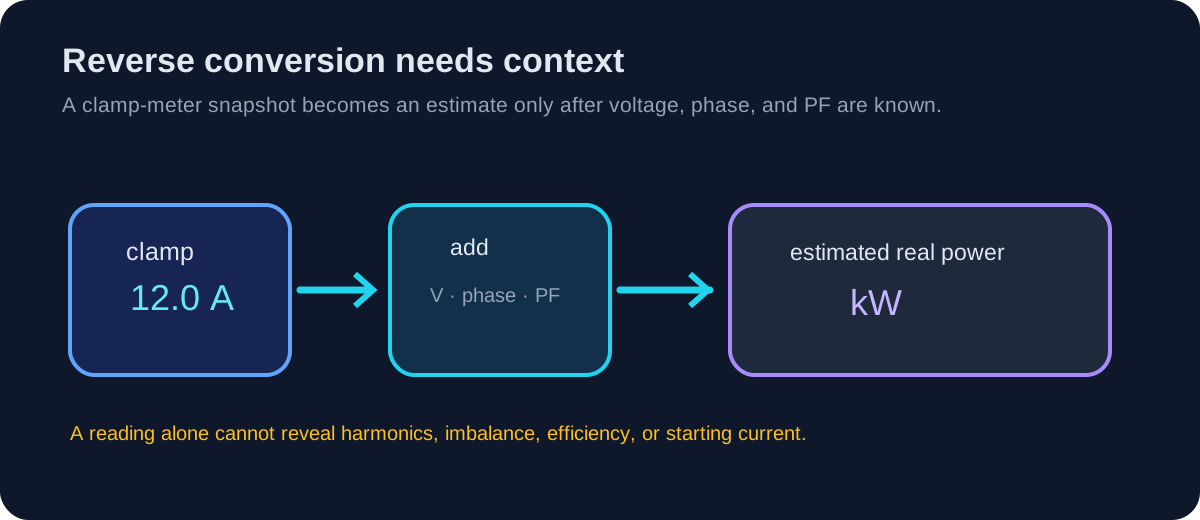
Clamp meter reading feeding voltage, phase, and power-factor inputs into an amps-to-kW calculation

Measured current is a snapshot, not a power meter

A clamp meter measures current at one point in time. To estimate real power, pair it with the voltage at the same operating condition and an appropriate PF. A fluctuating motor, thermostat-controlled heater, charger, or VFD can change its real kW while the displayed current lags or leads the change.

Rated current is different again: it may represent full-load current, a design maximum, or a manufacturer test condition rather than the current being consumed right now.

Three clamp-meter examples

Example 1 — heater: 20 A at 240 V, single-phase, PF 1.0 estimates 4.80 kW.

Example 2 — workshop motor: 12 A at 415 V L-L, three-phase, PF 0.82 estimates 7.07 kW of real electrical input before efficiency is considered.

Example 3 — DC battery bus: 35 A at 48 V estimates 1.68 kW because the DC relationship has no PF term.

What a current reading cannot tell you

A single current reading cannot identify phase imbalance, harmonic RMS current, motor efficiency, starting surge, standby losses, or whether a generator value is kW or kVA. A true-power meter, power-quality analyser, or three-phase measurement may be required.

For a motor, use input electrical kW for this reverse conversion. Converting shaft output kW requires efficiency and a clear definition of where the measurement was made.

  • Use the actual voltage, not the nominal label, when voltage drop is material.
  • Select L-L or L-N explicitly for three-phase measurements.
  • Treat the output as estimated real power, not a guaranteed billable or nameplate value.

When reverse conversion is useful

The result helps trend a running load, compare a measured installation with a nameplate, or sanity-check a generator or inverter operating point. It is not a substitute for a revenue-grade energy meter or a protection-coordination study.

Continue with the right context

Page-specific FAQs

Can current alone determine kW?

No. You also need voltage and, for AC, phase arrangement and power factor. For motors, efficiency is needed to relate shaft output to electrical input.

Should I enter nameplate current or clamp-meter current?

Use clamp-meter current for an operating-load estimate and nameplate current for a full-load comparison. Label which one you used because they answer different questions.

Why does a motor’s estimated kW change during the day?

Load torque, speed, PF, voltage, and efficiency change with operating point. Current is not a fixed proxy for real power.

Does the three-phase result mean total kW per line?

No. The result is total real power represented by the three line current and voltage relationship; it is not three times the displayed kW.

When is a clamp meter insufficient?

When harmonics, imbalance, rapidly changing loads, or accuracy requirements matter. Use a suitable true-power or power-quality instrument.