kW to Amps Logo
kW to Amps
Conversion

5 kW to Amps

Complete conversion table for 5 kW to Amps at common voltages for both single-phase and three-phase systems.

Quick Answer

Single Phase (240V, PF 0.9)

23.15 A

I = 5000 / (240 × 0.9)

Three Phase (415V L-L, PF 0.85)

8.18 A

I = 5000 / (√3 × 415 × 0.85)

5 kW to Amps - Single Phase

Power Factor = 0.9 (typical for mixed loads)

Voltage Region Current (PF 0.8) Current (PF 0.9) Current (PF 1.0)
120V USA 52.08 A 46.30 A 41.67 A
220V Asia 28.41 A 25.25 A 22.73 A
240V UK/AU 26.04 A 23.15 A 20.83 A

Formula: I = P / (V × PF) = 5000W / (V × PF)
5 kW to Amps - Three Phase

Line-to-Line voltage, Power Factor = 0.85

Voltage (L-L) Application Current (PF 0.8) Current (PF 0.85) Current (PF 0.9)
415V 3-Phase 8.70 A 8.18 A 7.73 A
440V Industrial 8.20 A 7.72 A 7.29 A
480V USA 3-Phase 7.52 A 7.08 A 6.68 A

Formula: I = P / (√3 × V × PF) = 5000W / (1.732 × V × PF)

How to Calculate 5 kW to Amps

Single Phase Example

To convert 5 kW to Amps at 240V with a power factor of 0.9:

I = P / (V × PF)

I = 5000 W / (240 V × 0.9)

I = 5000 / 216

I = 23.15 A

Three Phase Example

To convert 5 kW to Amps at 415V (L-L) with a power factor of 0.85:

I = P / (√3 × V × PF)

I = 5000 W / (1.732 × 415 V × 0.85)

I = 5000 / 610.96

I = 8.18 A

Page intent

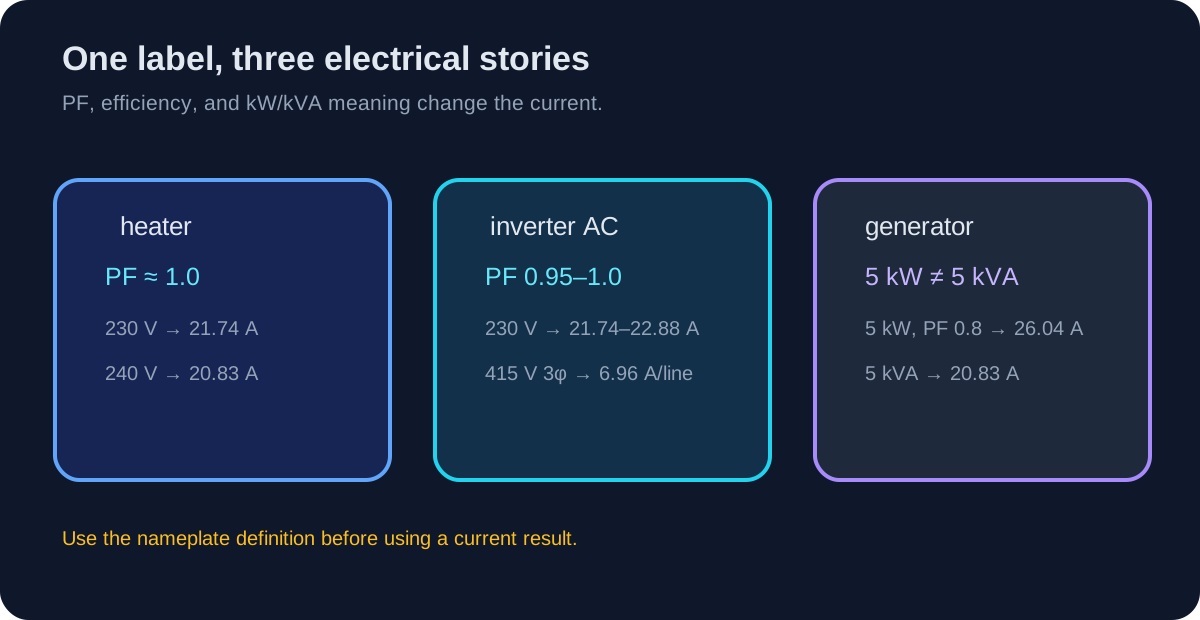
Five kilowatts is not one electrical scenario. A resistive heater, an inverter AC output, and a generator nameplate can all be described as 5 kW while requiring different assumptions about PF, efficiency, duty, and whether the rating is kW or kVA.

Comparison of current drawn by a 5 kW heater, solar inverter, and generator under different power-factor assumptions

5 kW resistive heater

A near-pure resistive heater normally uses PF approximately 1.0. At 230 V single-phase, 5,000 / 230 = 21.74 A; at 240 V single-phase, 5,000 / 240 = 20.83 A; at 400 V three-phase L-L, 5,000 / (√3 × 400) = 7.22 A per line.

Thermostatic cycling and staged heating elements mean the measured current may be zero, full stage current, or a combination rather than a constant 5 kW. Continuous-load and circuit-sizing rules vary by jurisdiction; the heater nameplate and installation instructions take priority.

5 kW solar inverter: AC output, not DC-array current

For the inverter AC-output side, 230 V single-phase at PF 1.0 is 21.74 A, while PF 0.95 is 22.88 A. At 415 V three-phase L-L and PF 1.0, the result is 6.96 A per line.

Inverter current limits, export limits, grid-code settings, adjustable displacement PF, and conversion efficiency determine the real operating point. The DC array voltage and current require a separate calculation, and a 5 kW array does not produce 5 kW continuously.

5 kW generator versus 5 kVA generator

For 5 kW real power at 240 V single-phase and PF 0.8, current is 26.04 A. A 5 kVA apparent-power rating at 240 V is 5,000 / 240 = 20.83 A, and at PF 0.8 that 5 kVA represents only 4 kW usable real power.

Starting loads, continuous rating, voltage regulation, and the generator nameplate limit the practical load. Do not silently convert a kVA label into kW.

Continue with the right context

Page-specific FAQs

Can a 5 kW heater run on a typical domestic circuit?

It may require a high-current or dedicated circuit. Check the actual voltage, continuous-load rules, heater nameplate, terminal temperature, and service capacity rather than assuming a standard outlet is suitable.

Is a 5 kW solar inverter rated by DC input or AC output?

The wording matters. This page’s inverter examples are AC-output examples; the DC array side has separate voltage, current, efficiency, and MPPT limits.

Is a 5 kW generator the same as a 5 kVA generator?

No. kW is real output and kVA is apparent capacity. At PF 0.8, 5 kVA corresponds to only 4 kW real power.

Why can a 5 kW motor draw more current than a heater?

A motor has PF below 1.0 and efficiency below 100%, and it can draw much more current during starting.

Does a 5 kW three-phase load draw the listed current on every line?

The displayed result is approximate current per line under a balanced-load assumption. Imbalance and harmonics can make actual phase currents differ.

Related Conversions

Calculator

Interactive Calculator

Custom kW to Amps conversion

3-Phase

3-Phase Calculator

Dedicated three-phase converter

Reference

Conversion Chart

Complete reference tables