kW to Amps Logo
kW to Amps
Conversion

7 kW to Amps

Complete conversion table for 7 kW to Amps at common voltages for both single-phase and three-phase systems.

Quick Answer

Single Phase (240V, PF 0.9)

32.41 A

I = 7000 / (240 × 0.9)

Three Phase (415V L-L, PF 0.85)

11.46 A

I = 7000 / (√3 × 415 × 0.85)

7 kW to Amps - Single Phase

Power Factor = 0.9 (typical for mixed loads)

Voltage Region Current (PF 0.8) Current (PF 0.9) Current (PF 1.0)
120V USA 72.92 A 64.81 A 58.33 A
220V Asia 39.77 A 35.35 A 31.82 A
240V UK/AU 36.46 A 32.41 A 29.17 A

Formula: I = P / (V × PF) = 7000W / (V × PF)
7 kW to Amps - Three Phase

Line-to-Line voltage, Power Factor = 0.85

Voltage (L-L) Application Current (PF 0.8) Current (PF 0.85) Current (PF 0.9)
415V 3-Phase 12.17 A 11.46 A 10.82 A
440V Industrial 11.48 A 10.81 A 10.21 A
480V USA 3-Phase 10.52 A 9.91 A 9.36 A

Formula: I = P / (√3 × V × PF) = 7000W / (1.732 × V × PF)

How to Calculate 7 kW to Amps

Single Phase Example

To convert 7 kW to Amps at 240V with a power factor of 0.9:

I = P / (V × PF)

I = 7000 W / (240 V × 0.9)

I = 7000 / 216

I = 32.41 A

Three Phase Example

To convert 7 kW to Amps at 415V (L-L) with a power factor of 0.85:

I = P / (√3 × V × PF)

I = 7000 W / (1.732 × 415 V × 0.85)

I = 7000 / 610.96

I = 11.46 A

Page intent

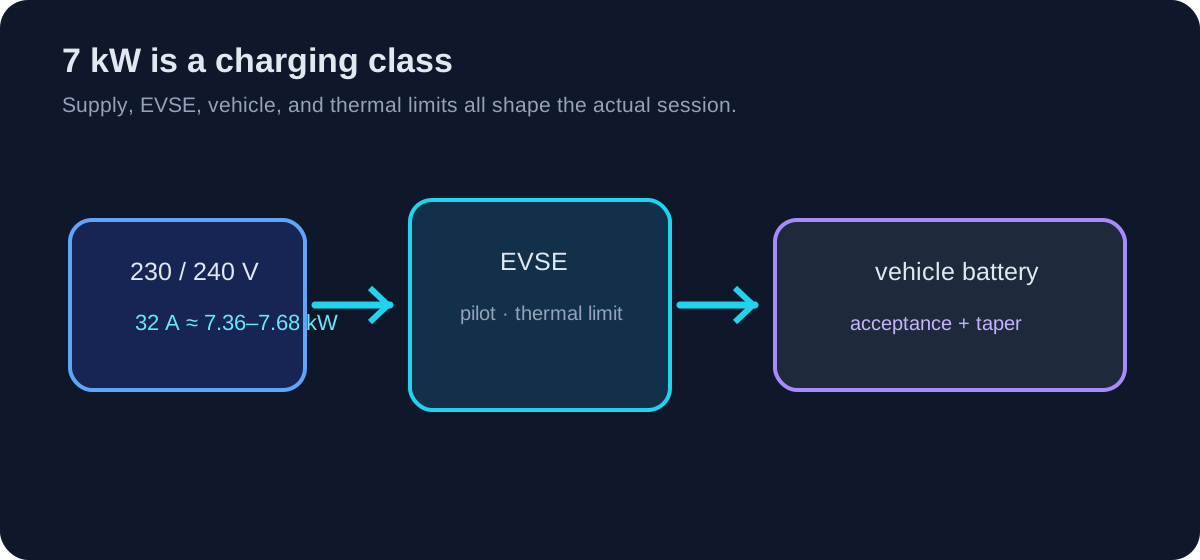
Seven kilowatts is often used as shorthand for home EV charging, but the actual current depends on voltage, PF, EVSE settings, vehicle acceptance, and installation limits.

Seven kilowatt EV charging power flow from supply through EVSE to the vehicle

Why “7 kW charger” is near a 32 A circuit

At 230 V single-phase and PF 1.0, 32 A represents 7.36 kW. At 240 V and PF 1.0, the same 32 A represents 7.68 kW, so a nominal 7 kW charger is a practical label rather than an exact universal current.

The EVSE, vehicle, supply voltage, pilot limit, connector temperature, and installation rules can all reduce the actual charging power.

230 V and 240 V comparisons

A 7 kW real load at 230 V PF 1.0 is 30.43 A; at 240 V it is 29.17 A. If the power-electronic input operates at PF 0.95, the 230 V estimate rises to 32.04 A.

Vehicle, EVSE, supply, and installation limits

A vehicle may accept less than the EVSE maximum, and an EVSE may be configured below its hardware limit. Voltage variation changes delivered power; thermal derating can reduce current after a sustained session; and the supply may impose a service or demand limit.

Treat the result as a planning estimate for a continuous load. The EVSE instructions, vehicle specification, supply capacity, protection, isolation, and local rules take priority.

Continue with the right context

Page-specific FAQs

Why is 230 V × 32 A about 7.36 kW?

At PF 1.0, real power is V × I, so 230 × 32 / 1000 is 7.36 kW. The label “7 kW” is a nominal class, not an exact promise.

Do all 7 kW chargers draw the same current?

No. Vehicle acceptance, EVSE configuration, voltage, PF, connector temperature, and supply limits can change current and delivered power.

Is EV charging a continuous load?

A charging session can last for hours, so design it as a sustained load under the applicable installation rules rather than relying on a short-term average.

Can a 7 kW charger use a 240 V supply?

Only if the EVSE and supply arrangement are rated for that voltage and the installation meets the manufacturer and local requirements.

Does battery state of charge change charger current?

It can. The vehicle’s charging strategy may taper power as the battery fills or as temperature changes.

Related Conversions

Calculator

Interactive Calculator

Custom kW to Amps conversion

3-Phase

3-Phase Calculator

Dedicated three-phase converter

Reference

Conversion Chart

Complete reference tables