kW to Amps Logo
kW to Amps
Motor Calculations

Electric Motor kW to Amps

Calculate Full Load Amps (FLA) for AC electric motors. Essential for selecting cables, circuit breakers, and starters.

Motor Current Calculator

Estimates current based on power, voltage, PF, and efficiency

Estimated Full Load Amps
10.38
Amps (A)

Motor Full Load Amps Chart (Approximate)

Values based on 400V 3-Phase, PF 0.85, Efficiency 0.9

Motor kW Approx Amps (400V) Approx Amps (415V)
0.37 kW 0.70 A 0.67 A
0.55 kW 1.04 A 1.00 A
0.75 kW 1.42 A 1.36 A
1.1 kW 2.08 A 2.00 A
1.5 kW 2.83 A 2.73 A
2.2 kW 4.15 A 4.00 A
3 kW 5.66 A 5.46 A
4 kW 7.55 A 7.27 A
5.5 kW 10.38 A 10.00 A
7.5 kW 14.15 A 13.64 A
11 kW 20.75 A 20.00 A
15 kW 28.30 A 27.28 A
18.5 kW 34.91 A 33.64 A
22 kW 41.51 A 40.01 A
30 kW 56.60 A 54.56 A
37 kW 69.81 A 67.29 A
45 kW 84.90 A 81.84 A
55 kW 103.77 A 100.02 A
75 kW 141.51 A 136.39 A
90 kW 169.81 A 163.67 A
110 kW 207.54 A 200.04 A

How to Find Motor Amperage from kW

The nameplate on an electric motor usually provides the power rating in kilowatts (kW) or horsepower (HP). To find the amperage (current draw) for sizing cables and protection, you need to use the full load current formula.

Unlike a simple resistive heater, measuring motor amps requires considering two additional efficiency factors:

  • Power Factor (PF): Represents the phase shift between voltage and current. Typical motors range from 0.75 to 0.90.
  • Efficiency (η): No motor is 100% efficient. Some energy is lost as heat and friction. Typical efficiency is 80% to 95% (0.80 - 0.95).

Example Calculation

For a 11 kW motor connected to a 415V 3-phase supply, with a Power Factor of 0.85 and 90% Efficiency:

I = (11 × 1000) / (1.732 × 415 × 0.85 × 0.90)
I = 11000 / 549.88
I ≈ 20.00 Amps

Page intent

Motor kW is often shaft output, while the electrical input current depends on efficiency and PF. This page is for estimating running current and understanding why the nameplate remains the authority for equipment selection.

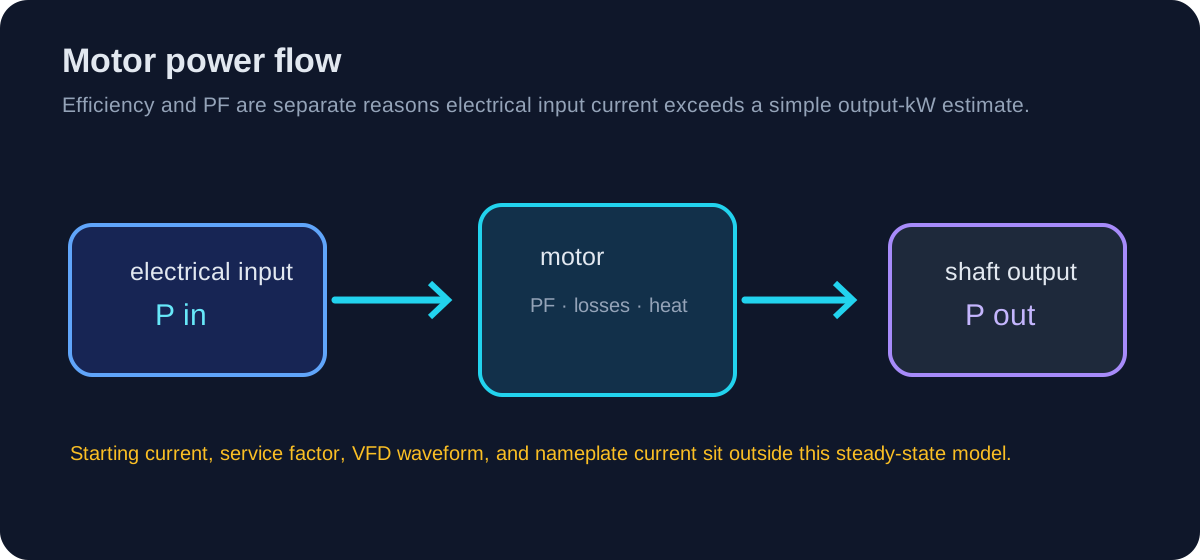
Motor power flow from electrical input through efficiency and power factor to shaft output

Output kW is not input kW

For an 11 kW motor at 415 V L-L, PF 0.85, and 90% efficiency, the estimated three-phase input current is 20.00 A. The efficiency term is separate from PF: it accounts for shaft output being lower than electrical input real power.

At part load, both PF and efficiency can move away from their full-load values. A calculator result using a single assumed pair is therefore an estimate, not a substitute for a nameplate or measured current.

Running, starting, and service-factor current

Full-load current is the steady current at rated output and rated voltage. Direct-on-line starting can draw several times that current until the rotor accelerates. A soft starter or VFD changes the starting profile, but it does not erase motor thermal limits or the need to follow the drive and motor manuals.

Service factor describes allowed overload capability under specified conditions; it is not permission to treat the calculated current as a universal overload setting. Voltage imbalance can produce disproportionate current imbalance and heating.

Pump, fan, and VFD context

A centrifugal pump or fan often has a load that changes strongly with speed. A VFD can reduce speed and real power, but the line-side current, displacement PF, harmonics, bypass path, and motor derating depend on the drive and installation. A simple PF-only equation cannot predict every VFD operating point.

Use motor nameplate current first when checking an existing motor. Use the calculator to explain a result or sanity-check an early estimate, not to select a breaker, overload relay, contactor, or cable without applicable-code and manufacturer data.

A practical motor checklist

Record rated voltage and connection, phase count, frequency, output kW or HP, nameplate current, PF, efficiency, service factor, duty, starting method, ambient conditions, and any VFD instructions before making a design decision.

Continue with the right context

Page-specific FAQs

Why is motor nameplate current higher than a basic kW calculation?

The nameplate may reflect efficiency losses, PF, rated conditions, service factor, temperature, and manufacturer test margins that a simple equation does not capture.

Does a VFD change motor line-side current?

It can. The drive changes frequency, waveform, displacement PF, harmonics, and operating point. Use the drive and motor documentation for line-side and motor-side limits.

Can calculated FLA be used as the overload setting?

No. Overload settings depend on code, motor nameplate, service factor, ambient conditions, and the protection device instructions.

Why can motor current rise when voltage falls?

To maintain torque, an induction motor may draw more current as voltage falls, and imbalance can cause additional heating. The exact response depends on the motor and load.

Is starting current included in the result?

No. The result is a steady-state estimate. Locked-rotor or acceleration current needs motor and starter data.