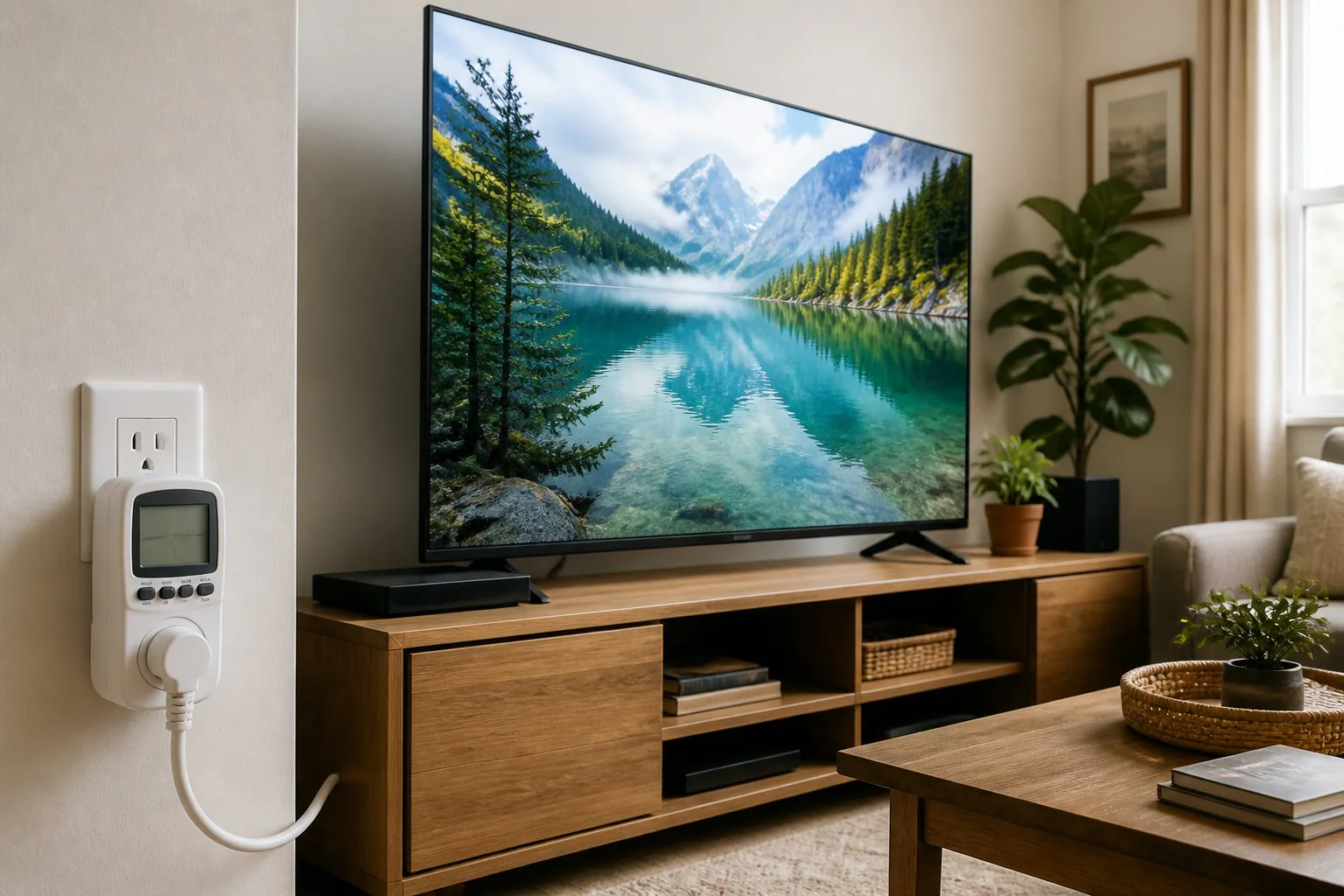
How many amps does a TV use? A modern television commonly draws about 0.25 to 1.7 amps from a 120V outlet if its operating power falls between 30 and 200 watts. On a 230V supply, the same range equals roughly 0.13 to 0.87 amps. These are estimates, not fixed ratings.
The exact TV amp draw depends on the model, screen size, display technology, brightness, picture mode, and content being shown. A television may also use a different amount of power during startup, normal viewing, HDR playback, software updates, and standby mode.
For the most reliable answer, check the electrical label on the back of the TV or its product manual. If it gives watts instead of amps, divide the wattage by the supply voltage. Battery-powered and RV setups need a separate calculation because inverter losses increase current on the DC side.
Quick Answer
Use the following formula for a basic estimate:
TV amps = TV watts ÷ supply voltage
A 100W television would theoretically draw:
- 0.83 A at 120 V
- 0.45 A at 220 V
- 0.43 A at 230 V
- 0.42 A at 240 V
- 8.33 A at 12 V DC
If a household TV runs from a 12V battery through an inverter, include inverter efficiency:
Battery amps = TV watts ÷ (battery voltage × inverter efficiency)
At 90% inverter efficiency, a 100W TV would draw approximately 9.26 A from a 12V battery.
How Many Amps Does a TV Use at Common Voltages?
Televisions do not have one standard amperage. The current changes with both wattage and operating voltage.
The following television amperage comparison chart shows ideal results calculated from A = W ÷ V:
| TV operating power | 120 V | 220 V | 230 V | 240 V | 12 V DC |
|---|---|---|---|---|---|
| 30 W | 0.25 A | 0.14 A | 0.13 A | 0.13 A | 2.50 A |
| 50 W | 0.42 A | 0.23 A | 0.22 A | 0.21 A | 4.17 A |
| 75 W | 0.63 A | 0.34 A | 0.33 A | 0.31 A | 6.25 A |
| 100 W | 0.83 A | 0.45 A | 0.43 A | 0.42 A | 8.33 A |
| 120 W | 1.00 A | 0.55 A | 0.52 A | 0.50 A | 10.00 A |
| 150 W | 1.25 A | 0.68 A | 0.65 A | 0.63 A | 12.50 A |
| 200 W | 1.67 A | 0.91 A | 0.87 A | 0.83 A | 16.67 A |
| 250 W | 2.08 A | 1.14 A | 1.09 A | 1.04 A | 20.83 A |
The 12V column describes direct DC use. A regular AC television powered through an inverter will draw more battery current than the ideal values because the inverter consumes some energy.
Finding the Exact Amperage of Your Television
A screen-size estimate can be useful when planning, but the specific model’s information is better. Three methods can give you a more dependable figure.
Read the rear label
Look for an electrical label near the power connection or on the rear panel. It may show:
- input voltage
- input frequency
- rated current
- rated power
- maximum power
- model number
If the label states both voltage and current, use its rated amperage when checking electrical compatibility. If it shows only watts, calculate the current using the applicable voltage.
Some labels provide a maximum input value rather than normal viewing consumption. The TV may usually draw less, but the maximum rating remains relevant when checking a power source.
Check the manufacturer’s specifications
Search for the exact model number rather than relying on a general description such as “55-inch smart TV.” Product documentation may list typical power, maximum power, standby consumption, or annual energy use.
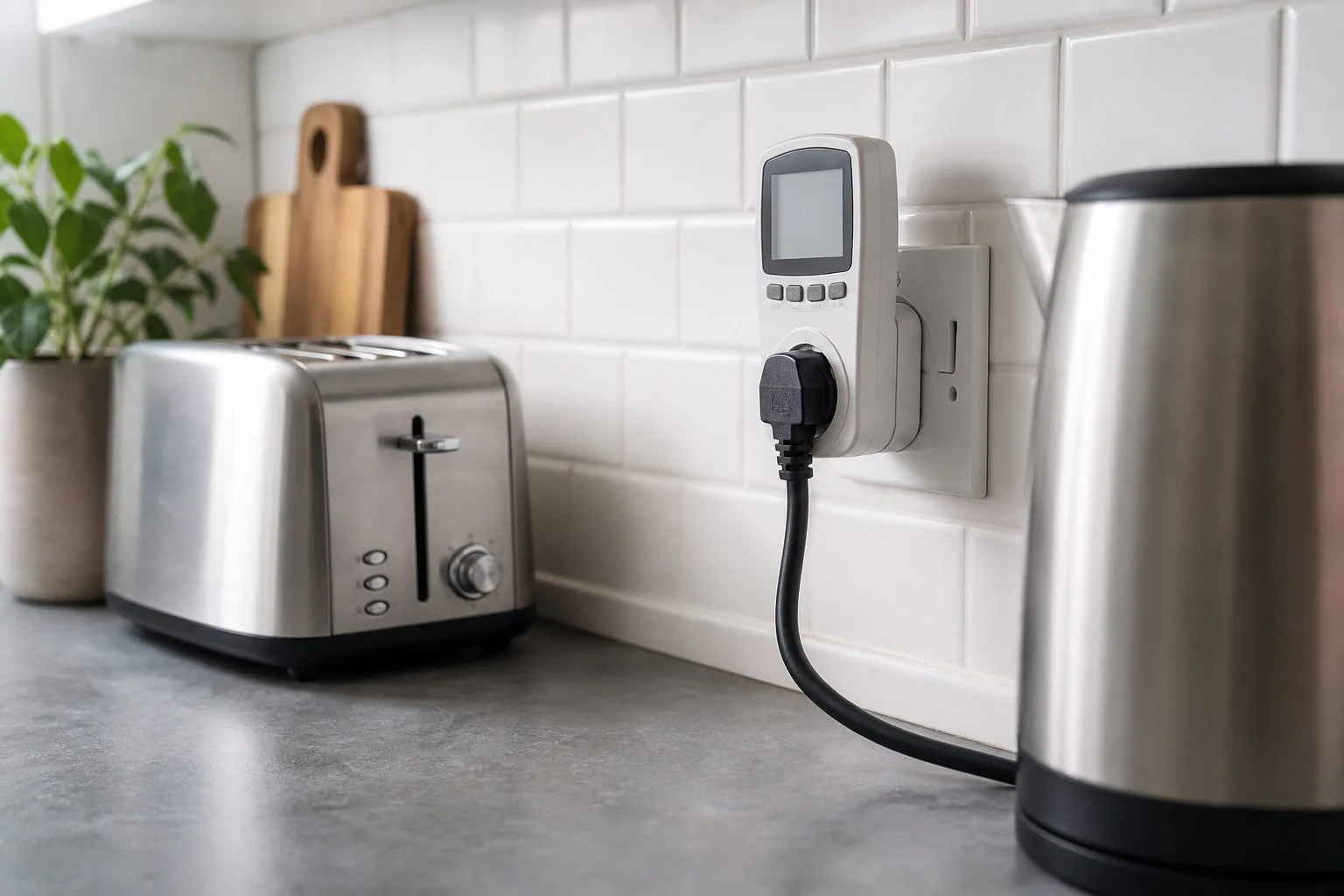
Measure actual power
A plug-in energy monitor can measure watts and accumulated kWh while the TV operates. Test representative material in the picture mode you normally use. A bright HDR program may produce a different reading from a dark movie or a menu screen.
The US Department of Energy’s television test procedure uses controlled video patterns and wattmeter readings, demonstrating why measured TV power consumption depends on defined content and test conditions. A casual reading should therefore be treated as a snapshot rather than a universal value.
TV Amps by Screen Size
Larger screens often consume more power because they illuminate a greater display area, but screen size alone does not determine current. An efficient newer model can use less energy than a smaller but older television.
The ranges below are broad planning estimates for modern TVs. Always confirm the actual model before selecting a battery, inverter, or other power source.
| Screen size | Illustrative power range | Approximate amps at 120 V | Approximate amps at 230 V |
|---|---|---|---|
| 24 inches | 20–40 W | 0.17–0.33 A | 0.09–0.17 A |
| 32 inches | 30–60 W | 0.25–0.50 A | 0.13–0.26 A |
| 43 inches | 45–90 W | 0.38–0.75 A | 0.20–0.39 A |
| 50 inches | 55–120 W | 0.46–1.00 A | 0.24–0.52 A |
| 55 inches | 60–150 W | 0.50–1.25 A | 0.26–0.65 A |
| 65 inches | 80–200 W | 0.67–1.67 A | 0.35–0.87 A |
| 75 inches | 100–250 W | 0.83–2.08 A | 0.43–1.09 A |
| 85 inches | 120–300 W | 1.00–2.50 A | 0.52–1.30 A |
A 55-inch TV amp draw can vary substantially between models. If one television uses 80 W, it draws about 0.67 A at 120 V. A 150 W model at the same voltage draws 1.25 A.
The same principle applies to a 65-inch TV amp draw. Quoting one amperage for every 65-inch model would ignore differences in brightness, panel design, image processing, speakers, and energy settings.
LED, OLED, QLED, and Other Display Types
Display technology affects power use, but the relationship is not simple enough to rank every television by its panel label.
LED and LCD televisions
Most TVs described as LED models use an LCD panel illuminated by an LED backlight. Their running power is influenced by backlight brightness, screen size, local dimming, picture mode, and energy-saving settings.
OLED televisions
OLED pixels produce their own light and can switch off for black areas. Energy consumption therefore changes with the image. Dark scenes may use less power than bright, full-screen content. Screen size, brightness, and what is being watched all affect OLED TV amp draw.
QLED and Mini-LED televisions
QLED is generally associated with an LCD-based display using a quantum-dot layer and a backlight. Mini-LED models use many smaller backlight zones. High brightness can increase power demand, especially in vivid modes or during bright HDR playback.
Plasma and CRT televisions
Older plasma and CRT televisions can have a higher current draw than many modern flat-screen TVs. Their age and design also make model-specific information particularly important. A general modern-TV range should not be applied automatically to older equipment.
Comparisons such as LED versus OLED TV power consumption should use exact models of similar size and brightness. The technology name alone does not reveal the final electricity use.
Why Brightness, HDR, and Picture Mode Matter
A television does not necessarily draw the same current throughout a movie.
The Department of Energy advises using an ENERGY STAR preset where practical and notes that picture settings such as vivid, sports, and cinema affect brightness and contrast. The selected mode can therefore change operating power. DOE television guidance recommends considering these settings when managing energy use.
Important factors include:
- backlight or OLED pixel brightness
- ambient-light sensing
- HDR content
- automatic brightness control
- vivid or dynamic picture mode
- screen size
- volume and speaker output
- connected USB devices
- network and smart features
- gaming and high-refresh-rate modes
ENERGY STAR states that certified televisions are, on average, more energy-efficient than conventional models across on, sleep, and idle modes. Its television product guidance can help when comparing models, although the individual product’s specifications remain the best source for its rating.
Does a TV Use Amps While on Standby?
Yes, many televisions consume a small amount of electricity while apparently turned off. Standby power may support the remote-control receiver, network connection, software updates, voice control, quick-start features, clocks, or scheduled functions.
Standby current is calculated using the same basic relationship. If a TV consumes 0.5 W in standby:
- At 120 V: 0.5 ÷ 120 = 0.0042 A
- At 230 V: 0.5 ÷ 230 = 0.0022 A
The current is small, but standby energy accumulates because the TV may remain in that state for many hours.
A network-connected smart TV can behave differently from a simple passive standby mode. Features such as wake-on-Wi-Fi, voice activation, and rapid startup may keep additional electronics active. Check the manual before disabling these functions because doing so may affect convenience or scheduled updates.
Amps, Amp-Hours, Watts, and kWh Are Different
The question “How many amps does a TV draw per hour?” mixes current with time. Amps describe current at a moment; they are not normally expressed “per hour.”
Amp-hours, or Ah, measure charge used or supplied over time. If a 12V system supplies a steady 9 A for three hours, it delivers:
9 A × 3 h = 27 Ah
Watts measure power. A 100 W TV uses energy at a rate of 100 watts while operating.
Kilowatt-hours measure energy. A 100 W TV operating for four hours uses:
100 W × 4 h ÷ 1,000 = 0.4 kWh
If it runs four hours every day for 30 days:
0.4 kWh × 30 = 12 kWh per month
This monthly TV electricity usage does not include a soundbar, game console, streaming box, or other connected equipment unless their consumption is added separately.
How Many Amps Does a TV Draw From a 12V Battery?
There are two common arrangements: a native 12V television or a standard household TV powered through an inverter.
A native 12V TV rated at 60 W theoretically draws:
60 ÷ 12 = 5 A
A standard AC television needs an inverter. To estimate its battery current, use:
Battery amps = TV watts ÷ (battery voltage × inverter efficiency)
For a 100 W TV, a 12 V battery, and 90% inverter efficiency:
Battery amps = 100 ÷ (12 × 0.90)
Battery amps ≈ 9.26 A
If the inverter itself consumes additional power that is not already reflected in its efficiency figure, include that standby or operating demand. Battery voltage also changes during discharge, so measured current will not remain perfectly constant.
Estimated 12V battery current through a 90% efficient inverter
| TV power | Battery calculation | Approximate current |
|---|---|---|
| 50 W | 50 ÷ (12 × 0.90) | 4.63 A |
| 75 W | 75 ÷ (12 × 0.90) | 6.94 A |
| 100 W | 100 ÷ (12 × 0.90) | 9.26 A |
| 150 W | 150 ÷ (12 × 0.90) | 13.89 A |
| 200 W | 200 ÷ (12 × 0.90) | 18.52 A |
The current drawn from a 12V battery is much higher than the current drawn from a 120V or 230V outlet because the battery-side voltage is much lower.
How Long Will a 100Ah Battery Run a TV?
Runtime depends on battery voltage, usable depth of discharge, inverter efficiency, TV power, and any additional loads.
Use:
Runtime = (Battery volts × Ah × usable fraction × inverter efficiency) ÷ TV watts
Suppose a 12V 100Ah battery has an 80% usable operating window and powers a 100 W TV through a 90%-efficient inverter:
Usable delivered energy = 12 × 100 × 0.80 × 0.90
Usable delivered energy = 864 Wh
Then:
Runtime = 864 ÷ 100
Runtime ≈ 8.64 hours
This is a planning estimate. Actual runtime may be shorter because of inverter idle use, battery age, temperature, discharge behavior, voltage cutoff, connected accessories, and changing TV consumption.
Do not assume that every 100Ah battery should be discharged by the same percentage. Use the manufacturer’s recommended operating limits for the specific chemistry and model.
Estimating TV Electricity Cost
Current alone does not determine the electricity bill. You need energy consumption in kWh and the electricity price.
Use:
Monthly kWh = TV watts ÷ 1,000 × hours per day × days
Then:
Monthly cost = monthly kWh × electricity rate
For a 120 W TV operating five hours daily for 30 days:
Monthly energy = 120 ÷ 1,000 × 5 × 30
Monthly energy = 18 kWh
At an example electricity rate of $0.20 per kWh:
Monthly cost = 18 × $0.20 = $3.60
Replace the sample rate with the rate shown on your electricity bill. Include taxes or time-of-use pricing if you need a closer estimate.
Does a Television Need a Dedicated Circuit?
Most modern televisions draw relatively little current compared with heating or cooking appliances, so they usually share a household circuit with other electronics. The total connected load matters, not the TV alone.
A television setup may also include:
- an AV receiver
- powered speakers or a soundbar
- a game console
- a streaming device
- a cable or satellite receiver
- a subwoofer
- decorative lighting
- a computer or media server
Add the power or current of devices that may operate at the same time. Avoid overloading extension leads or power strips, and follow their ratings.
If a breaker trips repeatedly, plugs become hot, outlets are damaged, or lights flicker when equipment starts, stop treating the issue as a simple TV amperage question. Have the circuit and connected equipment checked by a qualified person.
Frequently Asked Questions
How many amps does a typical TV use?
A modern TV using 30–200 W draws approximately 0.25–1.67 A at 120 V or 0.13–0.87 A at 230 V. The exact value depends on the model, operating power, picture settings, and content. Check the rear label or measure wattage for a better answer.
How many amps does a 55-inch TV use?
A 55-inch television using 60–150 W would draw about 0.50–1.25 A at 120 V or 0.26–0.65 A at 230 V. This is an illustrative range rather than a specification for every 55-inch model. Display technology and brightness can shift consumption.
How many amps does a 65-inch TV use?
If a 65-inch television consumes 80–200 W, its estimated current is 0.67–1.67 A at 120 V or 0.35–0.87 A at 230 V. Large, high-brightness models may use more, so verify the exact model’s label or technical data.
How many amps does a TV use at 120V?
Divide its wattage by 120. A 60 W television draws approximately 0.50 A, a 100 W model draws 0.83 A, and a 150 W TV draws 1.25 A. These are basic estimates; a manufacturer’s current rating accounts for the actual product design.
How many amps does a TV use at 230V?
Divide the TV’s watts by 230 for a simple estimate. A 50 W TV draws about 0.22 A, a 100 W model draws 0.43 A, and a 200 W television draws approximately 0.87 A at 230 V.
Does an OLED TV use more amps than an LED TV?
Not always. OLED consumption varies with screen content because each pixel produces its own light. An LCD-based LED TV depends heavily on backlight settings. Screen size, brightness, HDR use, picture mode, and model efficiency can matter more than the technology label alone.
How much power does a TV use on standby?
Some modern TVs consume less than one watt in simple standby, but network and quick-start features may increase standby use. The exact figure is model-specific. Look for standby power in the product specifications or measure it with a suitable plug-in energy monitor.
What size inverter do I need for a TV?
Start with the TV’s maximum rated wattage and add any connected devices. Choose an inverter whose continuous output comfortably exceeds that combined load and whose output voltage and waveform suit the equipment. Also verify battery-side current, wiring, fuse protection, and the inverter manufacturer’s instructions.
Use the TV’s Actual Rating for the Best Answer
The most accurate response to “How many amps does a TV use?” comes from the specific television’s wattage and operating voltage. Divide watts by volts for a basic estimate, then use the nameplate current or manufacturer documentation when checking compatibility with a circuit, generator, inverter, or power station.
For battery use, calculate on the DC side and include inverter losses. For electricity cost, work in kWh rather than amps. Screen size and display type provide helpful clues, but the TV’s real power data gives the answer that matters.