kW to Amps Logo
kW to Amps
Voltage Specific

kW to Amps at 240 Volts

Instant conversion for 240V electrical systems. Ideal for home appliances, EV chargers, and HVAC systems.

240V Amperage Calculator

1.0 for heaters/EV chargers, 0.8 for motors

Current Draw at 240V
30.00
Amps (A)

240V Conversion Chart

Values for typical household loads

Power (kW) Amps (PF 1.0) Amps (PF 0.8) Common Usage
3.6 kW 15.00 A 18.75 A Small EV Charger (16A)
7.2 kW 30.00 A 37.50 A Standard EV Charger (32A)
9.6 kW 40.00 A 50.00 A Electric Shower (40A)
1 kW 4.17 A 5.21 A -
2 kW 8.33 A 10.42 A -
3 kW 12.50 A 15.63 A -
3.6 kW 15.00 A 18.75 A -
5 kW 20.83 A 26.04 A -
7.2 kW 30.00 A 37.50 A -
9 kW 37.50 A 46.88 A -
10 kW 41.67 A 52.08 A -
15 kW 62.50 A 78.13 A -
20 kW 83.33 A 104.17 A -

Page intent

A 240 V entry is useful when the equipment is labelled for a 240 V single-phase supply, but the supply arrangement, conductor configuration, and actual measured voltage still control compatibility.

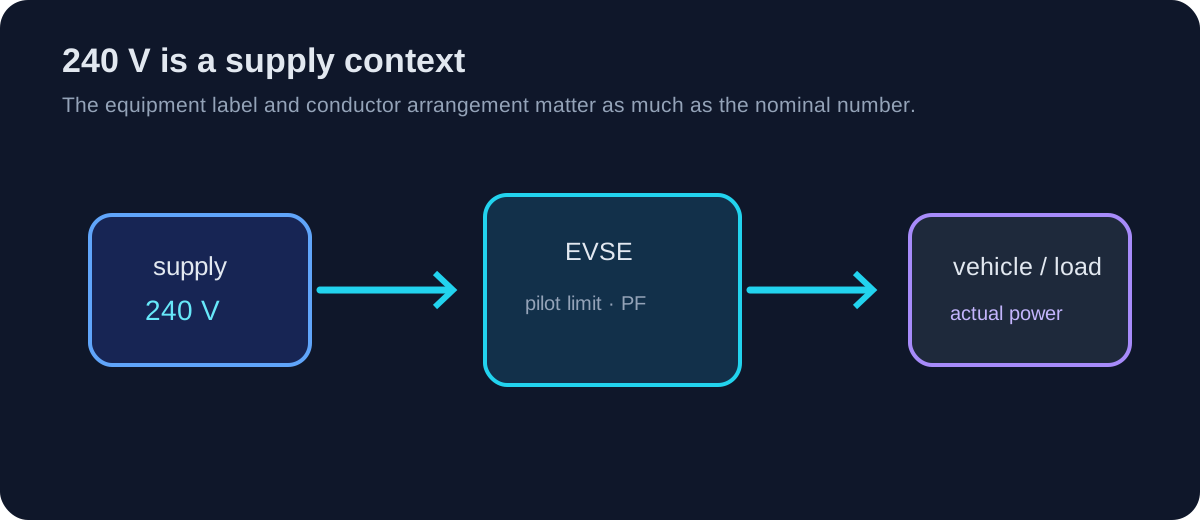
240 V single-phase load diagram showing supply conductors, EVSE, and current path

240 V is a supply context, not a universal standard

A 240 V nominal input may be line-to-line in a split-phase arrangement or a line-to-neutral value in another system. Read the equipment label and measure the supply rather than inferring the topology from the number alone.

At PF 1.0, a 7.2 kW EVSE estimate is 30.00 A. At PF 0.8, the same real power would be 37.50 A.

Worked example: charger or appliance

A nominal 7 kW charger is not guaranteed to draw exactly one fixed current. Vehicle acceptance, EVSE pilot settings, supply voltage, connector temperature, and installation limits can reduce the actual charging power. The same principle applies to electric showers, ovens, heat pumps, and HVAC equipment.

  • Confirm the equipment voltage and maximum input current.
  • Check whether the load is continuous or cycles under control.
  • Allow for voltage drop, connector heating, and local continuous-load rules.

Common 240 V mistake

Using a 240 V single-phase equation for a 240 V three-phase L-N input, or assuming a 240 V receptacle has the same earthing and neutral arrangement everywhere, can create an unsafe design assumption. Follow the nameplate, supply diagram, and local installation requirements.

Continue with the right context

Page-specific FAQs

Is 240 V always line-to-line?

No. It may be line-to-line in a split-phase supply or line-to-neutral in another configuration. Confirm the actual conductors and equipment label.

Why can a 7.2 kW charger draw less than 30 A?

The vehicle or EVSE can limit power, and actual voltage may differ from nominal. PF and control behaviour can also change the input current.

Can I compare a 240 V heater with a 240 V motor directly?

Only after accounting for PF, starting behaviour, duty cycle, and the actual supply. The same voltage does not mean the same current waveform or operating profile.

What should I check before using a 240 V result?

Check voltage notation, nameplate current, conductor arrangement, continuous duty, voltage drop, protection, and the applicable installation rules.