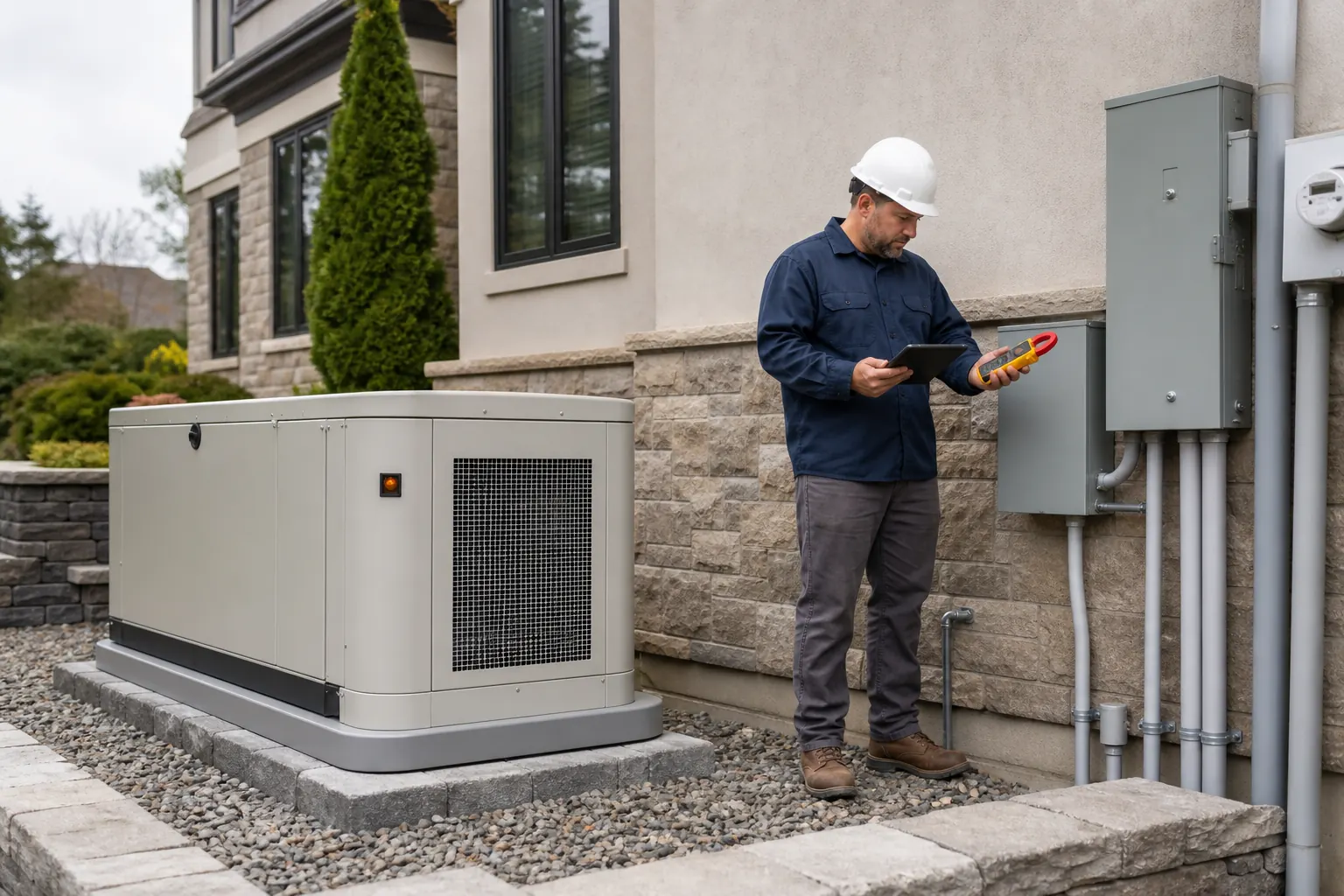
If you are asking what size generator for 300 amp service, begin with this distinction: a 120/240 V single-phase 300 A service has a theoretical capacity of 72 kVA, or 72 kW at unity power factor. However, that does not mean every property with this service needs a 72 kW generator.
Generator size should be based on the loads that must operate during an outage, not only the main service rating. Running demand, air-conditioner and pump starting requirements, fuel-specific generator output, load management, and transfer-switch design can all change the result.
A smaller standby generator may support selected or automatically managed circuits. Matching the unrestricted theoretical capacity of the entire service is a different goal and may require a much larger unit. Final sizing requires a documented load calculation and verification by a qualified generator professional or licensed electrician.
The Short Answer Depends on Your Backup Goal
There are three valid ways to approach a 300 A property:
| Backup objective | Sizing basis | Main limitation |
|---|---|---|
| Full-service capability | Up to 72 kVA at 240 V single-phase | May require a large generator and substantial fuel supply |
| Managed whole-home backup | Simultaneous demand plus starting performance | Selected heavy loads must be delayed or shed |
| Essential-load backup | Prioritized circuits plus the largest credible start | Nonessential loads remain unavailable |
A 22 kW, 24 kW, or 26 kW generator does not provide 300 A at 240 V. It may still work on a property with 300 A service if the connected backup load is limited and managed correctly.
A full-capacity design must support both the real power in kW and the apparent power in kVA. It must also tolerate the largest expected motor-starting or step-load event without unacceptable voltage or frequency drop.
Why Service Amperage Is Not Actual Generator Demand
The 300 A service rating describes how much current the electrical service and its associated equipment are designed to accommodate under specified conditions. It is not a measurement of what the property uses continuously.
A large house may have 300 A service because it includes:
- two HVAC systems
- electric heat
- electric cooking
- multiple water heaters
- a pool or hot tub
- workshop equipment
- one or more EV chargers
- a well or irrigation pump
- two main electrical panels
These loads are not necessarily active together. The actual peak may be much lower than the theoretical service capacity, particularly when some loads are noncoincident.
Generator sizing therefore begins by identifying what must run during an outage. The main breaker rating provides context, but it does not replace a generator demand-load calculation.
What Size Generator for 300 Amp Service at Full Capacity?
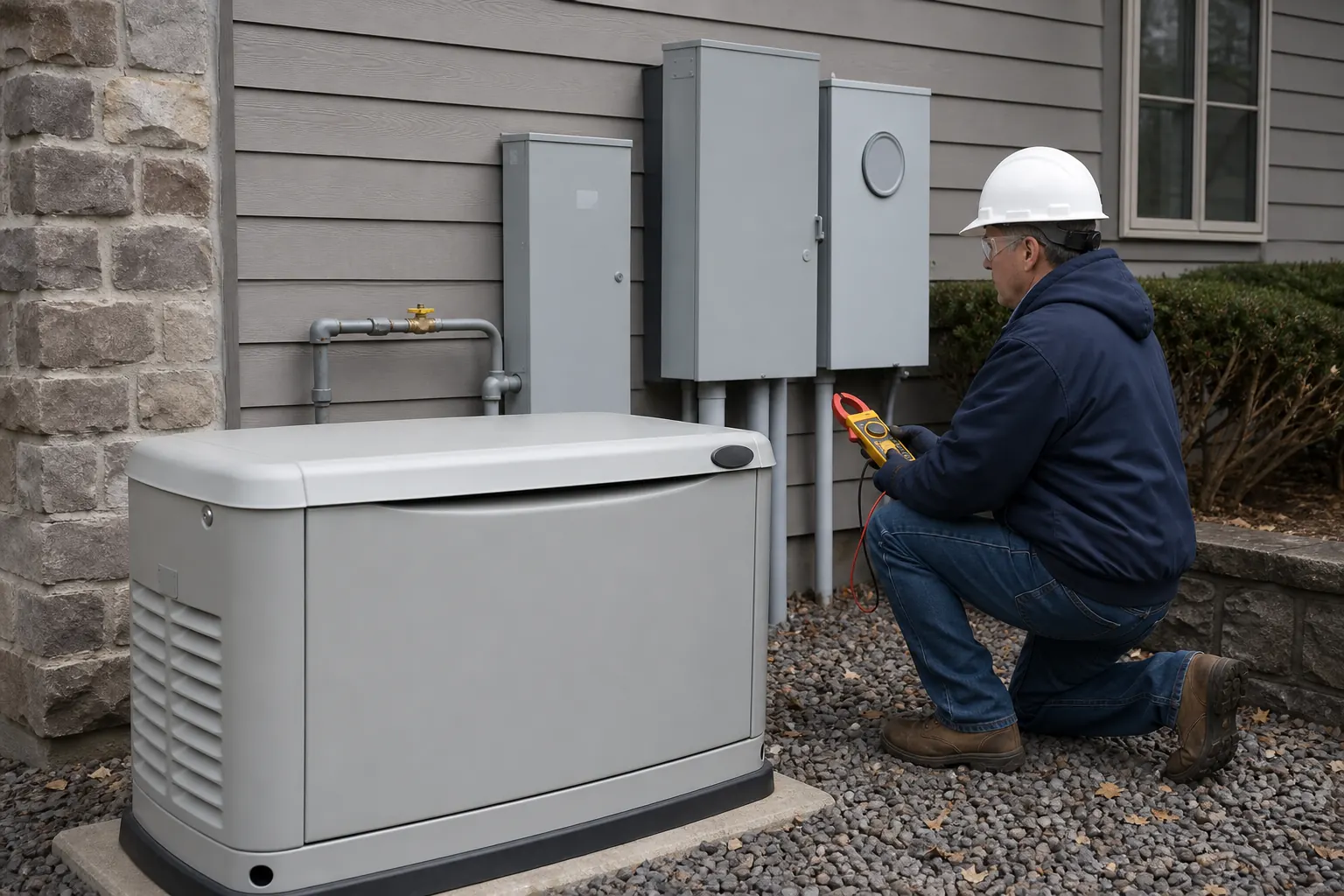
For the usual North American residential assumption of 120/240 V single-phase power, apparent capacity is:
S(kVA) = (V × I) ÷ (1000)
Insert 240 V and 300 A:
S = (240 × 300) ÷ (1000)
S = 72 kVA
At unity power factor, real power is:
P(kW) = (V × I × PF) ÷ (1000)
P = (240 × 300 × 1) ÷ (1000)
P = 72 kW
Therefore, an unrestricted mathematical match for 300 A at 240 V is 72 kVA and 72 kW at power factor 1.
At a power factor of 0.8:
P = (240 × 300 × 0.8) ÷ (1000)
P = 57.6 kW
The load still represents 72 kVA because it still requires 300 A at 240 V. This is why a generator must be checked for both kW and kVA capacity. Selecting a 57.6 kW unit without checking its kVA, current, and transient ratings could produce an undersized system.
You can use the site’s amps to kW calculator to convert 300 amps to kilowatts under different voltage, phase, and power-factor assumptions.
Decide What Must Operate During an Outage
A useful load list should separate equipment into three groups.
Loads that must remain powered
These may include refrigeration, medical equipment, sump pumps, well pumps, heating controls, security systems, selected lighting, internet equipment, and necessary receptacles.
Loads that are desirable but manageable
Examples include central air conditioning, one electric water heater, a pool pump, cooking equipment, laundry appliances, and a second HVAC system. They may be powered when generator capacity is available but temporarily disconnected during a larger starting event.
Loads that can remain off
EV charging, resistance backup heat, a hot tub, sauna, large workshop machinery, and other discretionary loads can place substantial demand on a generator. Leaving them disconnected can reduce the required capacity considerably.
The calculation should use loads expected to operate at the same time. It should not blindly total every circuit-breaker rating because breaker ratings do not represent normal equipment consumption.
How Three Backup Plans Change the Result
Consider an illustrative all-electric property with the following running loads:
| Load | Illustrative running power |
|---|---|
| Lighting and selected receptacles | 2.0 kW |
| Refrigerator and freezer | 1.0 kW |
| Well pump | 1.5 kW |
| First HVAC system | 5.5 kW |
| Second HVAC system | 5.5 kW |
| Electric range | 8.0 kW |
| Water heater | 4.5 kW |
| Clothes dryer | 5.0 kW |
| Pool pump | 1.5 kW |
| EV charger | 11.5 kW |
These illustrative values total 46 kW before motor-starting performance is considered. Real equipment must be evaluated using nameplates, specifications, and an approved load-calculation method.
Unrestricted backup
If every listed load must remain available without automatic management, the generator must support the applicable coincident running demand and the largest credible starting event. Simply selecting a 46 kW nameplate rating would not prove that the generator can start both HVAC compressors or the well pump under the expected preload.
Managed whole-home backup
A load-management system could temporarily disconnect the EV charger, dryer, range, or water heater when an HVAC compressor starts. It could reconnect lower-priority equipment when capacity becomes available.
This arrangement allows many circuits to remain connected without permitting every heavy load to operate simultaneously.
Essential-load backup
If the backup plan includes selected lighting, refrigeration, the well pump, and only one HVAC system, the running total may be far lower. The generator must still start the largest motor while carrying the other active loads, but it does not need to match the entire 300 A service.
These scenarios show why service size alone cannot produce one correct generator recommendation.
Account for HVAC, Pumps, and Starting Demand
Motors and compressors can draw much more current while starting than they require after reaching normal speed. Air conditioners, heat pumps, well pumps, sump pumps, refrigeration compressors, and pool equipment deserve separate attention.
Useful nameplate or manufacturer information may include:
- running load amps
- full-load amps
- locked rotor amps
- starting current
- rated voltage
- phase
- power factor
- motor horsepower
- soft-start or variable-speed characteristics
For small portable loads, users often add running watts and the largest surge-watt figure. Large standby systems require more careful analysis. Generator response depends on the motor, alternator, engine, existing preload, starting method, allowable voltage dip, and allowable frequency dip.
Do not convert locked rotor amps directly into a final generator size without using the manufacturer’s generator-sizing data or suitable engineering software.
Staggered starting can also matter. Two compressors starting at different times may require less generator capacity than the same units attempting to start together.
Load Management Can Support a Smaller Generator
Load management prevents selected equipment from operating when doing so would overload the generator. It may prioritize one HVAC system, delay an electric water heater, or block EV charging until other loads turn off.
This does not increase generator output. It controls the connected demand so the generator remains within its operating limit.
A managed design should define:
- which loads always receive power
- which loads can be shed
- their priority order
- how motor starts are detected
- how and when loads reconnect
- what happens after a generator overload or shutdown
- whether the equipment is compatible with the generator controller and transfer system
A 300 A transfer switch may be used in a properly designed system with a generator that produces less than 300 A. The switch rating describes its current-carrying and switching capability. It does not mean the generator must produce 300 A.
Generator kW and Amps at 240 V
The following values show approximate current for 240 V single-phase output at power factor 1:
| Generator output | Approximate current |
|---|---|
| 22 kW | 91.7 A |
| 24 kW | 100 A |
| 26 kW | 108.3 A |
| 30 kW | 125 A |
| 36 kW | 150 A |
| 48 kW | 200 A |
| 60 kW | 250 A |
| 72 kW | 300 A |
The calculation is:
I = (P(kW) × 1000) ÷ (V × PF)
For example, a 48 kW generator at 240 V and unity power factor produces:
I = (48 × 1000) ÷ (240)
I = 200 A
These are mathematical equivalents, not purchasing recommendations. Actual nameplate output may change with fuel, model configuration, voltage, phase, temperature, altitude, and rating category.
The kW to amps calculator can convert generator kW to amps using the applicable electrical-system inputs.
Transfer-Switch Options for a Split 300 A Service
A 300 A residential service does not always use one 300 A panel. Depending on the installation, it may supply two 150 A panels, a 200 A and 100 A arrangement, or another approved combination of disconnects and panels.
Possible generator designs include:
- one appropriately rated transfer switch ahead of the backed-up service equipment
- separate transfer switches for individual panel feeders
- a dedicated emergency or essential-load panel
- service-rated transfer equipment with integrated load management
The correct arrangement depends on the existing service, number and location of disconnects, grounding and bonding design, utility requirements, available fault current, generator configuration, and locally adopted electrical code.
One generator can supply more than one panel, but the transfer and overcurrent equipment must be designed as a complete system. This is not determined by generator wattage alone.
Transfer equipment must prevent an unsafe connection between generator power and the utility source. Service-entrance work, grounding, bonding, feeder design, and transfer-switch installation should not be attempted from a general sizing article.
Fuel Type and Site Conditions Affect Available Output
A generator model may not provide identical output on natural gas and liquid propane. Always use the manufacturer’s rating for the actual fuel and operating voltage.
Fuel planning also includes:
- available natural-gas pressure
- gas-meter capacity
- pipe length and pressure loss
- propane storage and vaporization capacity
- expected outage duration
- other appliances using the same fuel system
Altitude and high ambient temperature can reduce engine output. Manufacturers publish derating instructions or use these conditions in their sizing software.
A generator that appears adequate at standard test conditions may require a different configuration at a high-elevation or high-temperature site. The selected fuel system must also support the generator under full operating demand, not merely during its no-load exercise cycle.
Residential Single-Phase and Commercial Three-Phase Are Different
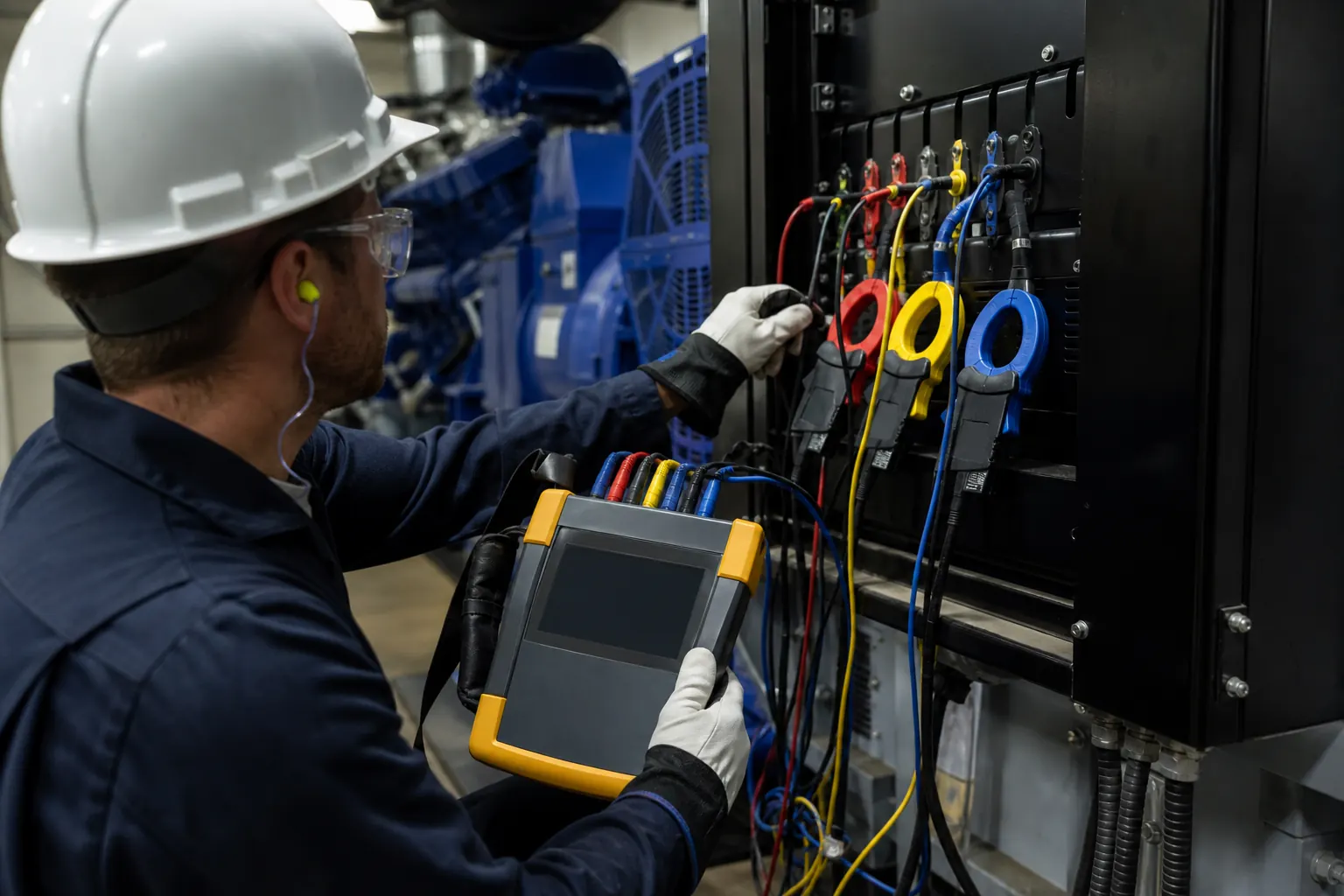
A 300 A commercial three-phase service has a different capacity from a 300 A residential single-phase service.
For balanced three-phase apparent power:
S(kVA) = (√3 × V_LL × I_L) ÷ (1000)
At 208 V three-phase:
S≈108.1 kVA
At 480 V three-phase:
S≈249.4 kVA
Never use the residential 72 kVA result for a three-phase property. Voltage, phase, power factor, load balance, motor starting, and generator connection must all match. Use the three-phase power calculator for a preliminary three-phase generator calculation.
For residential 120/240 V split-phase calculations, the single-phase current calculator provides the corresponding single-phase power calculation.
Final Selection Requires a Documented Load Calculation
The National Electrical Code addresses dwelling load calculations and optional standby systems, but the applicable edition and local amendments depend on the jurisdiction. Canadian installations follow different national and provincial requirements.
Final design should be reviewed by a licensed electrician, qualified generator professional, or electrical engineer as required. The local Authority Having Jurisdiction may also require documentation of the calculated load, equipment ratings, transfer arrangement, fuel system, and installation method.
Manufacturer sizing software is especially valuable where the project includes multiple motors, nonlinear loads, variable-frequency equipment, large HVAC systems, or staged load management.
The site’s electrical power formulas can help verify basic conversions, but they do not replace the required system-level assessment.
Frequently Asked Questions
How many kilowatts is a 300 amp service at 240 volts?
At 240 V single-phase, 300 A equals 72 kVA. It equals 72 kW only at unity power factor. At 0.8 power factor, the real power is 57.6 kW while apparent power remains 72 kVA. Generator selection must account for both quantities.
Does a 300 amp service require a 72 kW generator?
Not automatically. A 72 kVA, unity-power-factor design represents the theoretical full 300 A capacity at 240 V. A property backing up selected or load-managed circuits may need less. The correct size comes from simultaneous running demand and starting-load analysis.
Can a 22 kW or 26 kW generator work with 300 amp service?
It can work if the calculated backup demand stays within the generator’s continuous and starting capabilities. Such a generator cannot supply an unrestricted 300 A at 240 V. Heavy loads may need to be excluded, sequenced, or automatically shed.
Do I need a 300 amp automatic transfer switch?
Not in every design. The answer depends on which panels and circuits are backed up and where the transfer occurs. A whole-service arrangement may use a 300 A service-rated ATS, while selected-load designs may use smaller transfer equipment or an emergency-load panel.
Can one generator supply two main electrical panels?
Yes, if the transfer switches, disconnects, overcurrent protection, controls, feeders, grounding, bonding, and load management are designed as one coordinated system. The arrangement must match the service configuration and locally adopted requirements. It is not a simple matter of splitting the generator output.
How do air conditioners and heat pumps affect generator size?
Their compressors can impose a large starting load. Check running amps, locked rotor amps, starting method, manufacturer specifications, and generator transient-performance data. Electric resistance backup heat can add substantial continuous demand and may be excluded or managed during generator operation.
Does natural gas produce less generator output than propane?
It can, depending on the generator model. Some units have different nameplate ratings for natural gas and liquid propane. Use the manufacturer’s fuel-specific rating and confirm that the gas meter, regulator, piping, pressure, or propane system can support full-load operation.
Can a portable generator back up a 300 amp service?
A portable generator generally cannot supply the unrestricted capacity of a 300 A service. It may power selected circuits through properly installed, listed transfer equipment. Never connect a portable generator in a way that can energize utility lines or bypass required transfer protection.
Size the Backup Load, Not Just the Main Breaker
The safe answer to what size generator for 300 amp service begins with 72 kVA as the theoretical 240 V full-service capacity, not as an automatic purchasing recommendation.
Define the backup objective, calculate simultaneous running demand, evaluate the largest starting event, decide which loads can be managed, and verify fuel and site derating. A qualified professional can then match those requirements to a generator and transfer system approved for the property.