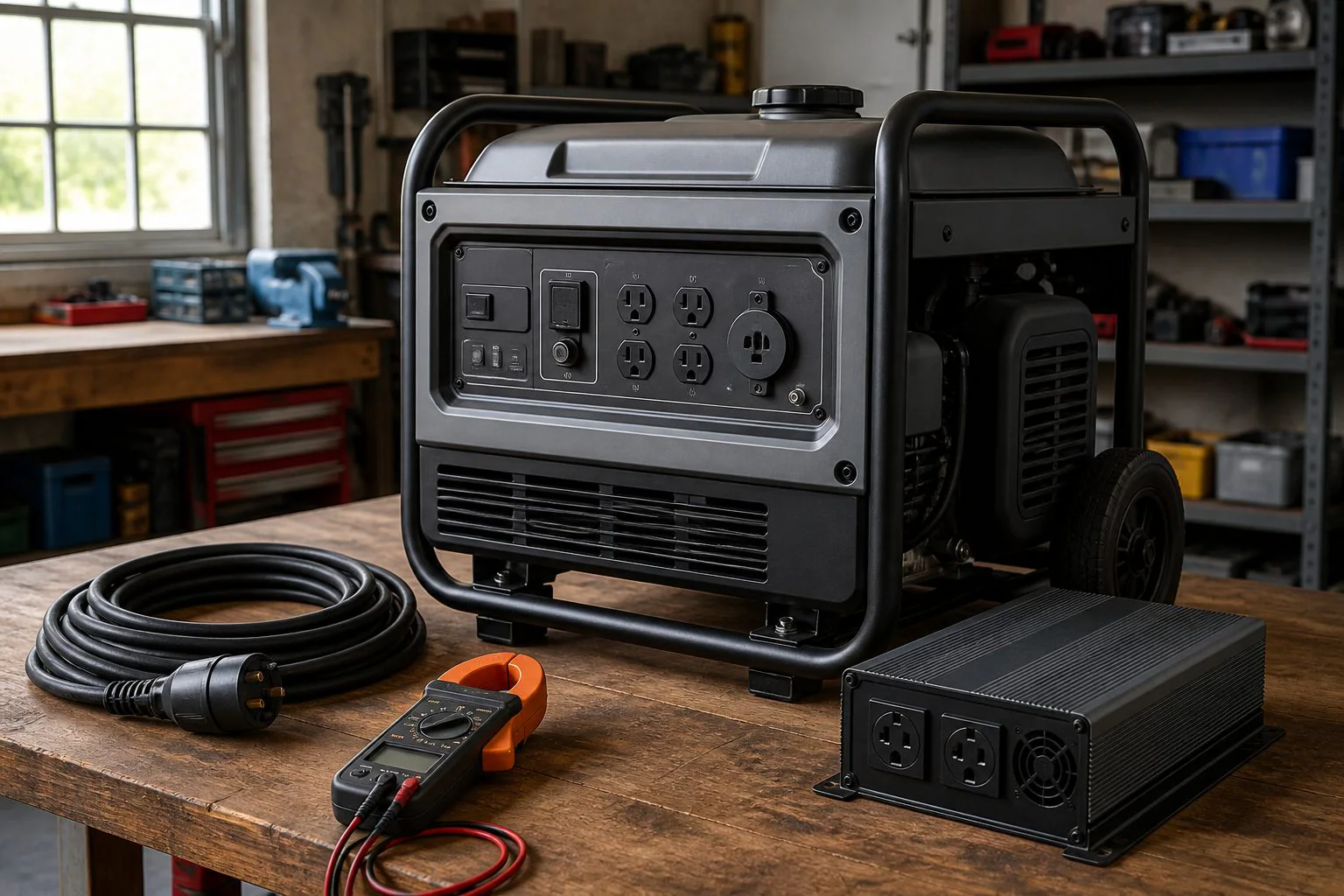
A 5000 watt to amps conversion does not produce one universal answer. Amperage depends on voltage, whether the supply is AC or DC, the number of phases, and—in an AC system—the load’s power factor. A 5,000-watt resistive load draws about 41.67 amps at 120 volts but only 20.83 amps at 240 volts.
Battery and inverter calculations are different again. A 5,000-watt inverter can theoretically draw 416.67 amps from a 12-volt battery bank, 208.33 amps at 24 volts, or 104.17 amps at 48 volts. Its actual DC input current will be higher because no inverter is 100% efficient.
This guide covers the correct formulas, common voltages, AC and DC systems, single-phase and three-phase power, inverter losses, and the difference between running watts and startup surge.
5000 Watt to Amps Quick Answer
For DC power or an ideal resistive AC load, divide watts by volts:
Amps = Watts ÷ Volts
Therefore:
- 5,000 W at 12 V = 416.67 A
- 5,000 W at 24 V = 208.33 A
- 5,000 W at 48 V = 104.17 A
- 5,000 W at 120 V = 41.67 A
- 5,000 W at 230 V = 21.74 A
- 5,000 W at 240 V = 20.83 A
These are theoretical values. Power factor affects AC calculations, while efficiency affects the DC current required by an inverter.
Why 5,000 Watts Does Not Equal a Fixed Number of Amps
Watts and amps measure different electrical quantities. A watt measures power—the rate at which energy is produced or consumed. An ampere measures electric current, or the flow of electric charge.
Voltage connects the two quantities. The basic relationship comes from Watt’s Law:
P = V × I
In this equation:
- P is electrical power in watts
- V is voltage in volts
- I is electric current in amps
Rearrange the equation to calculate current:
I = P ÷ V
If power remains fixed while voltage increases, current decreases. That is why a 5,000-watt load draws twice as much current at 120 V as it does at 240 V.
The basic equation works directly for DC circuits and resistive AC loads with a power factor of 1. Motors, transformers, some power supplies, and other AC equipment may require a power-factor adjustment.
5000 Watts to Amps Conversion Chart
This 5000 watt current draw by voltage chart assumes DC power or single-phase AC with a unity power factor. It does not include equipment losses.
| Voltage | Calculation | Current |
|---|---|---|
| 12 V | 5,000 ÷ 12 | 416.67 A |
| 24 V | 5,000 ÷ 24 | 208.33 A |
| 48 V | 5,000 ÷ 48 | 104.17 A |
| 110 V | 5,000 ÷ 110 | 45.45 A |
| 120 V | 5,000 ÷ 120 | 41.67 A |
| 208 V | 5,000 ÷ 208 | 24.04 A |
| 220 V | 5,000 ÷ 220 | 22.73 A |
| 230 V | 5,000 ÷ 230 | 21.74 A |
| 240 V | 5,000 ÷ 240 | 20.83 A |
| 277 V | 5,000 ÷ 277 | 18.05 A |
| 400 V | 5,000 ÷ 400 | 12.50 A |
| 415 V | 5,000 ÷ 415 | 12.05 A |
| 480 V | 5,000 ÷ 480 | 10.42 A |
The table demonstrates how voltage affects 5000 watt amperage, but it should not be used by itself to select a circuit breaker, cable, fuse, or disconnect. Those decisions require more information about the equipment and installation.
DC Watts to Amps Calculation
Direct current flows in one direction and is common in batteries, solar systems, vehicles, and the input side of power inverters.
Use this DC watts-to-amps formula:
I = P ÷ V
For 5,000 W at 48 V DC:
I = 5,000 ÷ 48
I = 104.17 A
This is the ideal current at exactly 48 V and 100% efficiency. Actual battery voltage changes with state of charge, chemistry, temperature, and load. Wiring and equipment also introduce energy losses.
5000 watts to amps at 12V DC
5,000 ÷ 12 = 416.67 A
This is an extremely high current. Even a small amount of resistance at a cable, lug, fuse holder, or connection can produce considerable heat and voltage drop.
5000 watts to amps at 24V DC
5,000 ÷ 24 = 208.33 A
Doubling the voltage from 12 V to 24 V halves the theoretical current.
5000 watts to amps at 48V DC
5,000 ÷ 48 = 104.17 A
A 48 V battery bank requires one-quarter of the current needed at 12 V to supply the same 5 kW of power under ideal conditions.
Single-Phase AC Watts to Amps
Single-phase AC power is common in homes and small commercial properties. For a resistive load with a power factor of 1, the basic formula remains:
I = P ÷ V
A 5,000-watt electric heater at 240 V would theoretically draw:
5,000 ÷ 240 = 20.83 A
A load with a power factor below 1 requires a different formula:
I = P ÷ (V × PF)
Here, PF represents power factor.
Suppose a 5,000 W single-phase load operates at 240 V with a power factor of 0.80:
I = 5,000 ÷ (240 × 0.80)
I = 26.04 A
Ignoring power factor would produce a result of 20.83 A, which understates the current by 5.21 A in this example.
Common single-phase results
| Voltage | PF = 1.00 | PF = 0.90 | PF = 0.80 |
|---|---|---|---|
| 110 V | 45.45 A | 50.51 A | 56.82 A |
| 120 V | 41.67 A | 46.30 A | 52.08 A |
| 208 V | 24.04 A | 26.71 A | 30.05 A |
| 220 V | 22.73 A | 25.25 A | 28.41 A |
| 230 V | 21.74 A | 24.15 A | 27.17 A |
| 240 V | 20.83 A | 23.15 A | 26.04 A |
Do not assume a power factor for final equipment planning. Check the equipment nameplate or manufacturer’s specifications. Resistive heating equipment may operate close to unity power factor, while inductive or electronic loads can behave differently.
Three-Phase Watts to Amps

Three-phase power is common in factories, workshops, data centers, and larger commercial facilities. For a balanced system using total real power and line-to-line RMS voltage, use:
I = P ÷ (√3 × V × PF)
The value of √3 is approximately 1.732.
For a 5,000 W three-phase load at 400 V and a power factor of 0.80:
I = 5,000 ÷ (1.732 × 400 × 0.80)
I ≈ 9.02 A
At a power factor of 1:
I = 5,000 ÷ (1.732 × 400)
I ≈ 7.22 A
Three-phase conversion table
| Line-to-line voltage | PF = 1.00 | PF = 0.90 | PF = 0.80 |
|---|---|---|---|
| 208 V | 13.88 A | 15.42 A | 17.35 A |
| 220 V | 13.12 A | 14.58 A | 16.40 A |
| 230 V | 12.55 A | 13.95 A | 15.69 A |
| 240 V | 12.03 A | 13.36 A | 15.04 A |
| 400 V | 7.22 A | 8.02 A | 9.02 A |
| 415 V | 6.96 A | 7.73 A | 8.70 A |
| 480 V | 6.01 A | 6.68 A | 7.52 A |
These figures assume a balanced load and line-to-line voltage. If voltage is given line-to-neutral, the applicable balanced-system formula is:
I = P ÷ (3 × Vₗ₋ₙ × PF)
The distinction matters. Mixing line-to-line and line-to-neutral voltage can produce an incorrect phase-current result.
How Many Amps Does a 5000 Watt Inverter Draw?
A power inverter changes DC electricity from a battery bank into AC electricity for appliances. Its AC output current and DC input current are not the same.
At full 5,000 W AC output, the ideal DC input current is:
- 416.67 A from a 12 V battery bank
- 208.33 A from a 24 V battery bank
- 104.17 A from a 48 V battery bank
Real inverters lose some energy during conversion. To estimate input current with efficiency included, use:
DC input amps = AC output watts ÷ (DC voltage × efficiency)
For a 5,000 W inverter operating at 90% efficiency:
| Battery voltage | Ideal current | Estimated current at 90% efficiency |
|---|---|---|
| 12 V | 416.67 A | 462.96 A |
| 24 V | 208.33 A | 231.48 A |
| 48 V | 104.17 A | 115.74 A |
For example, the 48 V calculation is:
5,000 ÷ (48 × 0.90) = 115.74 A
This remains an estimate. A manufacturer may quote peak efficiency under specific conditions, while actual efficiency can change with load, battery voltage, temperature, and operating mode. The inverter may also consume power when idle.
Use the manufacturer’s maximum DC input-current specification when selecting protection and conductors. Do not rely only on the rated AC output divided by nominal battery voltage.
5000 Watt Generator Amps and Output Ratings
A 5,000-watt generator can provide different current depending on its output voltage:
At 120 V: 5,000 ÷ 120 = 41.67 A
At 240 V: 5,000 ÷ 240 = 20.83 A
However, a generator label may distinguish between running watts and starting watts. Running watts describe the power the generator can deliver continuously under its specified conditions. Starting watts describe a higher short-duration output intended to handle appliance or motor startup.
If a generator is advertised as “5,000 starting watts” but provides only 4,000 running watts, its continuous theoretical output current is based on 4,000 W:
- 4,000 W at 120 V = 33.33 A
- 4,000 W at 240 V = 16.67 A
Some generators provide both 120 V and 240 V outlets, but that does not always mean the full nameplate power is available from one receptacle or one 120 V leg. Outlet ratings, winding configuration, breaker limits, load balance, altitude, temperature, and fuel type can affect usable output.
Read the generator manual and receptacle ratings instead of assuming every outlet can supply the generator’s full advertised wattage.
Running Watts, Starting Watts, and Surge Power
A device’s operating current may not tell the whole story. Resistive heaters usually have little difference between starting and running demand, but motors and compressors can draw substantially more current for a short period during startup.
This distinction affects equipment such as:
- refrigerators and freezers
- air conditioners
- water pumps
- air compressors
- workshop machinery
- power tools
- motor-driven appliances
A 5 kW inverter might support 5,000 W continuously and a higher surge for a few seconds, but surge duration and overload behavior vary by model. Likewise, a generator may advertise a 5,000 W peak that it cannot maintain continuously.
Use the continuous rating for normal load planning. Check startup or locked-rotor requirements for motor-driven equipment and compare them with the source’s surge rating and duration.
Can the Result Determine Breaker or Wire Size?

The calculated current is an input to electrical design, not a complete design answer.
Circuit and conductor requirements may depend on:
- whether the load is continuous
- conductor material and insulation rating
- ambient temperature
- installation method
- cable bundling
- cable length and voltage drop
- motor or transformer starting current
- terminal temperature ratings
- local electrical code
- equipment instructions
- required overcurrent protection
- available fault current
A common mistake is calculating 20.83 A for a 5,000 W load at 240 V and immediately selecting a breaker or wire from that number alone. Continuous-load rules or equipment-specific provisions may require additional capacity. Motor circuits can follow requirements different from those for resistive heaters.
Low-voltage inverter systems deserve particular care because the current can exceed 100 or even 400 amps. Connection quality, fuse interrupt rating, conductor routing, cable length, and terminal torque can all affect safety.
Electrical Safety First notes that understanding watts, volts, and amps helps prevent overloaded circuits and overheating. Have a qualified electrician or system designer confirm wiring, protection, grounding, disconnects, and code compliance.
Common Mistakes When Calculating 5kW to Amps
Converting without knowing voltage
Watts alone cannot determine current. You need at least the operating voltage, and AC calculations may require power factor and phase information.
Treating AC output and DC input as identical
A 5,000 W inverter delivering about 20.83 A at 240 V AC may take more than 100 A from a 48 V DC battery bank. These values describe different sides of the inverter.
Assuming efficiency is always 100%
Inverters, power supplies, motors, cables, and connections introduce losses. Input current will generally exceed the ideal result when output power is fixed.
Ignoring power factor
For an AC load, 5,000 W is real power. When power factor is below 1, apparent power and line current increase.
Confusing 5 kW with 5 kWh
Five kilowatts measures power. Five kilowatt-hours measures energy. A 5 kW load operating for one hour consumes 5 kWh; if it runs for two hours, it consumes 10 kWh.
Using the peak rating as continuous capacity
A generator or inverter may handle 5,000 W only as a temporary surge. Always compare the load with the continuous rating as well as the peak rating.
Frequently Asked Questions
How many amps is 5000 watts at 120 volts?
A 5,000-watt DC or resistive single-phase load at 120 V draws approximately 41.67 A. Use I = 5,000 ÷ 120. A single-phase AC load with a power factor below 1 will draw more current; at a power factor of 0.80, the result is approximately 52.08 A.
How many amps is 5000 watts at 240 volts?
At 240 V, 5,000 W equals approximately 20.83 A for DC or a resistive single-phase AC load with a power factor of 1. At a 0.90 power factor, the estimated current is 23.15 A; at a 0.80 power factor, it is 26.04 A.
How many amps is 5000 watts at 12 volts?
The ideal result is 416.67 A because 5,000 ÷ 12 = 416.67. If the calculation involves an inverter, its conversion losses increase the DC input current. At 90% efficiency and exactly 12 V, the estimated current needed to deliver 5,000 W is approximately 462.96 A.
How many amps is 5000 watts at 48 volts?
Five thousand watts at 48 V equals 104.17 A under ideal DC conditions. A 5,000 W inverter operating at 90% efficiency would require approximately 115.74 A at exactly 48 V. Actual current changes as battery voltage and inverter efficiency vary.
Can you convert 5000 watts to amps without voltage?
No. Watts measure power, while amps measure current. Voltage is required to connect them through I = P ÷ V. For an AC load, you may also need its power factor and whether the supply is single phase or three phase.
Does power factor affect 5000 watt current draw?
Yes, in an AC system. Current equals real power divided by voltage and power factor for single-phase loads. A 5,000 W load at 240 V draws 20.83 A at a power factor of 1 but 26.04 A at a power factor of 0.80.
How many amps does a 5000 watt generator produce?
A theoretical 5,000 W output equals 41.67 A at 120 V or 20.83 A at 240 V. The available current at a specific outlet may be lower because of receptacle ratings, breakers, generator configuration, and whether 5,000 W is a running or starting rating.
What breaker size is needed for a 5000 watt load?
Wattage alone is insufficient for selecting a breaker. The correct rating depends on voltage, continuous-load status, load type, conductor ampacity, starting current, terminal ratings, equipment instructions, and local code. Calculate operating current first, then have the circuit requirements verified for the specific installation.
The Answer Depends on the Complete Electrical System
For a basic 5000 watt to amps calculation, divide 5,000 by the operating voltage. The result is 41.67 A at 120 V, 20.83 A at 240 V, 208.33 A at 24 V, or 104.17 A at 48 V.
That simple formula is only the starting point. Add power factor for non-resistive AC loads, use the √3 factor for balanced three-phase systems, and include efficiency when estimating inverter input current. For wire, fuse, and breaker selection, follow the equipment documentation and applicable electrical rules rather than treating a conversion table as a complete system design.