kW to Amps Logo
kW to Amps
3-Phase Conversion

1 kW to Amps in 3 Phase

Complete conversion guide for 1 kilowatt to amperes in three-phase electrical systems at various voltages and power factors.

Quick Answer

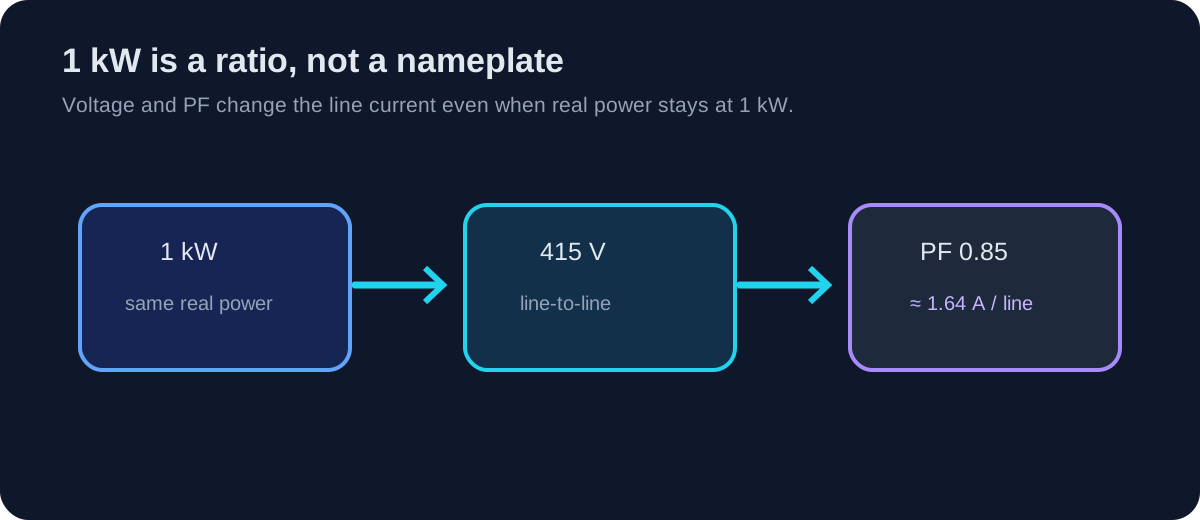
1 kW equals approximately 1.64 Amps in a three-phase system at 415V line-to-line with a power factor of 0.85.

at 400V (EU)

1.70 A

at 415V (AU/UK)

1.64 A

at 480V (USA)

1.42 A

1 kW to Amps 3-Phase Conversion Table

Line-to-Line voltage (VLL)

Voltage PF 0.8PF 0.85PF 0.9PF 0.95PF 1
380V(EU Standard) 1.90 A1.79 A1.69 A1.60 A1.52 A
400V(EU/UK) 1.80 A1.70 A1.60 A1.52 A1.44 A
415V(Australia/UK) 1.74 A1.64 A1.55 A1.46 A1.39 A
440V(Industrial) 1.64 A1.54 A1.46 A1.38 A1.31 A
480V(North America) 1.50 A1.42 A1.34 A1.27 A1.20 A

Formula for 1 kW to Amps (3-Phase)

I = P / (√3 × V × PF)

Variables

  • I = Line current in Amperes (A)
  • P = Power in Watts (1 kW = 1000 W)
  • V = Line-to-Line voltage in Volts (V)
  • PF = Power Factor (typically 0.8-0.95)
  • √3 = Square root of 3 (≈ 1.732)

Example Calculation

At 415V, PF = 0.85:

I = 1000 / (1.732 × 415 × 0.85)

I = 1000 / 610.85

I = 1.64 A

When Do You Need to Convert 1 kW to Amps?

Common Applications

  • Small three-phase motors (0.75-1.5 kW)
  • Pumps and fans
  • Compressors
  • Circuit breaker sizing
  • Cable selection

Why Power Factor Matters

Power factor affects the actual current draw. A lower power factor means higher current for the same power output.

  • PF 1.0: Ideal (resistive loads)
  • PF 0.85: Typical industrial motors
  • PF 0.8: Small motors at partial load
Calculator

3-Phase Calculator

Interactive three-phase converter

Learn

Formula Guide

Complete formula breakdown

Reference

Conversion Chart

Full conversion tables

Page intent

This page answers a narrow reference question: how much line current one real kilowatt represents in a balanced three-phase system at common L-L voltages and different PF values.

One kilowatt three-phase reference showing voltage and power factor changing line current

Read the 1 kW number as a sensitivity reference

At 415 V L-L, 1 kW is 1.39 A at PF 1.0, 1.55 A at PF 0.9, and 1.64 A at PF 0.85. The lower PF value is not a different amount of real power; it represents more current for the same real kW.

At PF 0.85 the same 1 kW is approximately 1.74 A at 400 V, 1.64 A at 415 V, and 1.42 A at 480 V. Always keep the L-L label beside the voltage.

Where this reference is useful

Use the ratio to scale a balanced load quickly, check a motor schedule, or compare a switchboard voltage. Do not use it as a direct nameplate rating: a motor’s efficiency, starting current, and operating point are separate questions.

  • Resistive heater: PF often near 1.0.
  • Induction motor: PF often below 1.0 and efficiency below 100%.
  • VFD or inverter: waveform and harmonic current need equipment data.

A precise assumption prevents a wrong answer

The same numeric voltage can mean different things depending on where it was measured. If a panel says 415 V L-L, do not put 415 V into the L-N option. If the equipment is a 230/400 V motor, the nameplate may be showing phase and line voltages together.

Continue with the right context

Page-specific FAQs

Why is the 415 V PF 0.85 value about 1.64 A?

Because 1,000 W is divided by √3 × 415 × 0.85. The PF term increases current relative to the PF 1.0 result.

Does 1 kW mean 1 kW on every phase?

No. It is total real three-phase power. The displayed value is the approximate current in each line under the balanced-load assumption.

Can I use this page for a motor?

Only as a first-order comparison. Motor efficiency, PF, starting current, and nameplate current must be considered separately.

Why does the table change with voltage?

For fixed real power and PF, current is inversely proportional to line-to-line voltage.